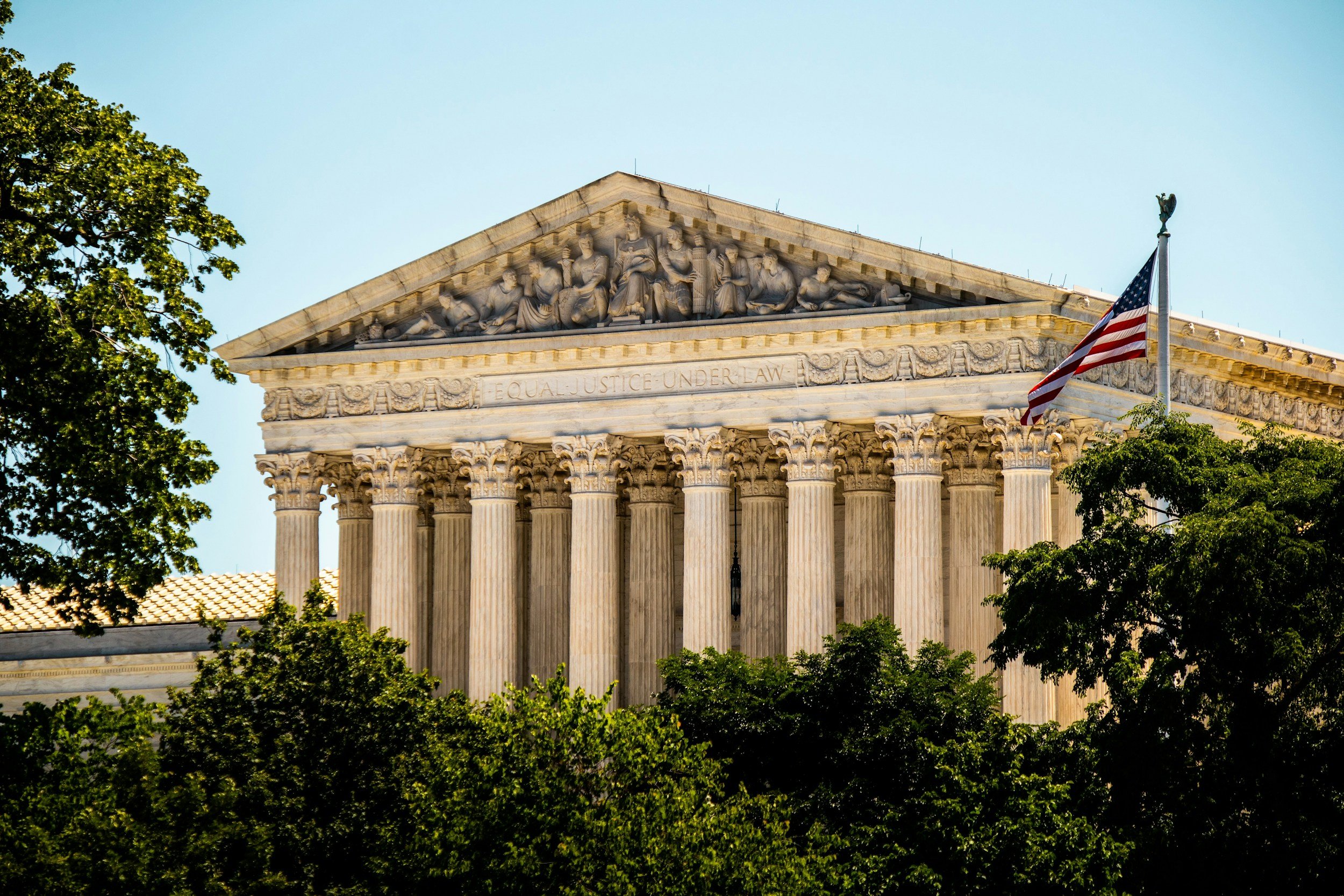
In response to today's Supreme Court decisions in Mullin v. Al Otro Lado and Noem v. Haitian Evangelical Clergy Association, Lawyers for Good Government (L4GG) issued the following statement.
Lawyers for Good Government (L4GG) was proud to join Congressman Troy A. Carter, Sr. (D-LA) and local and national climate justice leaders at an Environmental Justice Roundtable hosted at the Greater New Orleans Foundation. The discussion focused on recent harmful Environmental Protection Agency (EPA) decisions—including the termination of federal grant awards and the rollback of critical environmental protections—and how we can continue to push environmental justice forward under the Trump Administration.
Today, Lawyers for Good Government (L4GG) is proud to launch the Pro Bono Litigation Corps (PBLC)—a first-of-its-kind initiative mobilizing experienced attorneys to take on some of the most pressing constitutional challenges of our time.
As we commemorate the two-year anniversary of the Inflation Reduction Act (IRA) today, August 16, there is much to celebrate about this historic legislation. The IRA represents the largest-ever climate investment in our country’s history, creating unprecedented opportunities for clean energy savings.
However, we at L4GG are acutely aware that historically marginalized communities often lack the resources to access the IRA’s historic funding opportunities. In response, we have intensified our efforts over the past two years to ensure that the benefits of the IRA reach those who need them most. See what we’ve been up to!
Not enough people are talking about the water crisis in Jackson, MS. On Tuesday, the Mississippi governor declared a state of emergency for Jackson’s water system, the city’s largest treatment plant. Most of the city’s 150,000 residents are without running water, having to rely on bottled water for drinking, showering, brushing their teeth, and cooking.
Read L4GG’s official statement in response to President Donald Trump settling his $10 billion lawsuit against the IRS in exchange for a $1.776 billion fund to compensate those who claim they were targets of government "weaponization," and new reporting that the IRS will also be barred from pursuing tax claims against Trump.
Yesterday, the United States Supreme Court took the extraordinary step of immediately certifying its decision in Louisiana v. Callais, bypassing its own standard 32 day delay. In doing so, it gave Louisiana Republicans the green light to immediately redraw their congressional maps, hurting minority voters and upturning the regularity of our electoral system after votes have already been cast. The result: two majority-Black districts, drawn to give their residents fair shot at representation, are now at imminent risk of elimination after last week’s decision all but erased Section 2 of the Voting Rights Act.
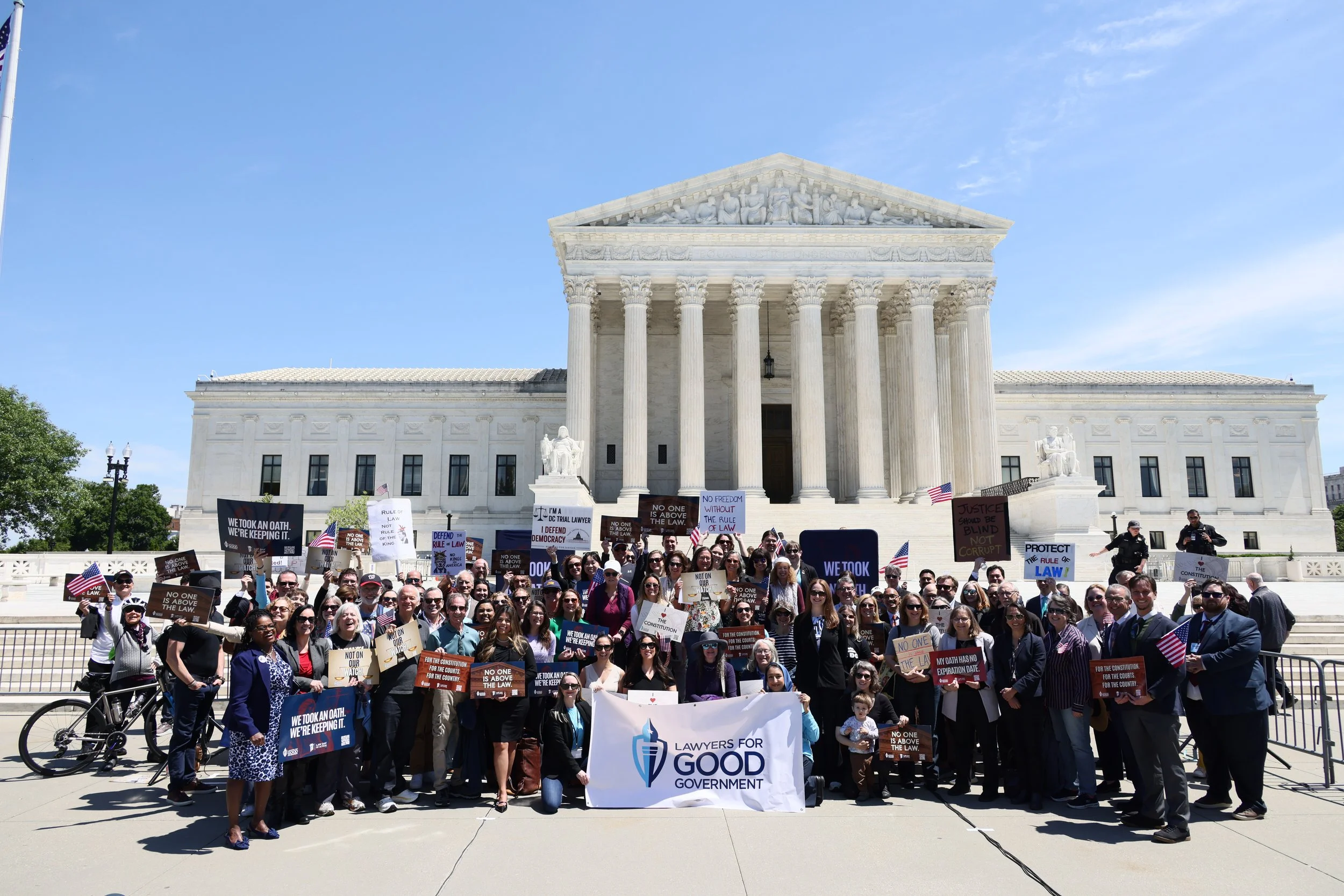
On May 1, 2026, the legal profession returned in force for the second annual National Law Day of Action. From the steps of the U.S. Supreme Court in Washington, D.C. to courthouses, plazas, and bar association halls across the country, lawyers, judges, and legal advocates publicly reaffirmed their oath to the Constitution and stood in defense of the rule of law.
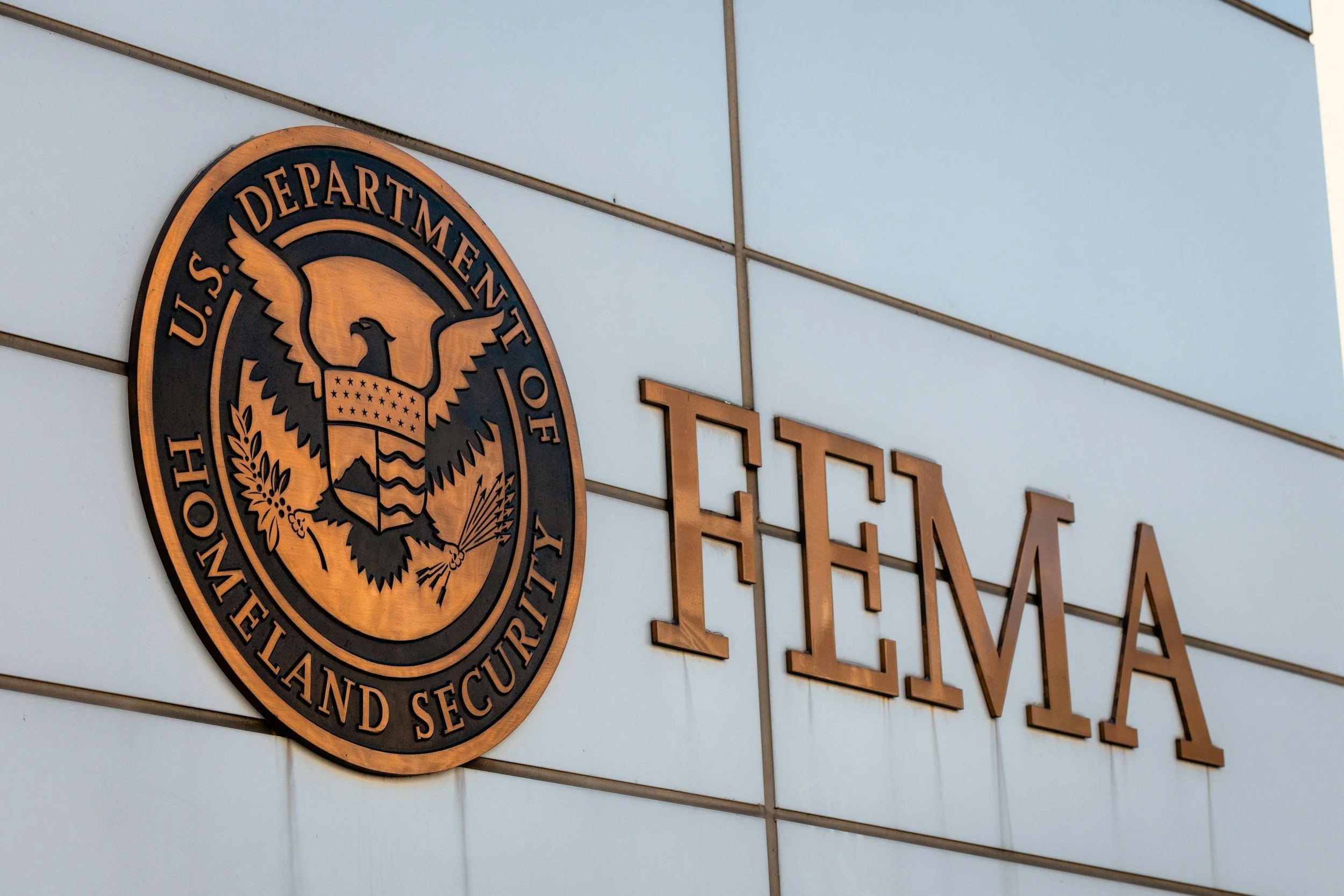
Yesterday, Federal Emergency Management Agency (FEMA) employees who were illegally placed on administrative leave for exercising their First Amendment and whistleblower rights were ordered back to work. On August 25, 2025, the employees sent a dissent letter to Congress—The FEMA Katrina Declaration—protesting gross waste and mismanagement, abuses of authority, dangers to public health and safety, and violations of laws, rules and regulations by Agency management.
Today, Lawyers for Good Government (L4GG) filed an amicus brief before the U.S. Supreme Court in Harris v. Bessent, urging the Court to uphold long-standing limits on presidential removal power and protect the independence of the Merit Systems Protection Board (MSPB), the agency responsible for adjudicating federal employee appeals.
The case centers on whether the President can remove MSPB members at will, an action L4GG argues would undermine due process protections for federal workers and erode the constitutional requirement of impartial adjudication.
L4GG filed the brief alongside amici Professors Nick Bednar, the McKnight Land-Grant Professor at the University of Minnesota Law School; Victoria Nourse, the Ralph V. Whitworth Professor in Law at Georgetown University Law Center; and Lawyers Defending American Democracy.
Professor Bednar, an expert in administrative law and the civil service, and Professor Nourse, a former appellate litigator at the Department of Justice and one of the nation’s foremost experts on Congress and its constitutional history, together provide historical and constitutional analysis demonstrating that Congress has long exercised its authority to insulate adjudicatory bodies from political interference.
The brief, which you can read in full here, argues:
The MSPB is a purely adjudicatory body. It functions like a court, hearing evidence, applying the law, and issuing binding decisions in disputes between federal employees and the government.
Congress has authority to protect adjudicatory independence. From the Founding era onward, Congress has created bodies insulated from political control to ensure fair and impartial decision-making.
At-will removal would violate due process. Allowing the President to remove MSPB members freely would compromise the neutrality of the tribunal and undermine the Fifth Amendment guarantee of a fair hearing.
Weakening MSPB independence risks system-wide consequences. Removing protections could destabilize the Board’s ability to function, leaving thousands of federal employees without a meaningful forum to challenge wrongful termination.
“The Constitution requires that when the government acts against its own employees, those individuals are entitled to a fair hearing before an impartial decisionmaker,” said Professor Nourse. “Allowing political control over that process would fundamentally undermine those protections.”
Lawyers for Good Government (L4GG) is a nonprofit organization that harnesses the power of 125,000 lawyers, law students, and advocates in the fight for justice. We identify where lawyers can make the greatest impact and mobilize them to defend democracy and the rule of law, protect civil and human rights, and advance environmental justice through coordinated legal action and advocacy efforts that create meaningful change for all Americans.
On April 21, 2026, the U.S. Department of Justice announced an indictment of the Southern Poverty Law Center (SPLC), an organization that has spent decades documenting hate groups, defending vulnerable communities, and holding extremist organizations accountable in court. The indictment is the latest escalation in a coordinated pattern we have watched unfold for well over a year: law firms targeted by executive order, judges threatened for lawful rulings, civil rights protections unlawfully rescinded, and now civil rights organizations themselves pulled into the crosshairs.
Traci Feit Love, Founder and Executive Director of Lawyers for Good Government, released the following statement in response:
“This administration is using the Department of Justice to punish organizations that protect Americans from hate and discrimination, and to send a message to every nonprofit, law firm, and advocate in this country: fall in line, or you are next. We refuse that choice. As lawyers, we swore an oath to support the Constitution, and we will act in accordance with that oath. Lawyers for Good Government stands with SPLC, with The Leadership Conference on Civil and Human Rights, and with every civil rights organization under attack. An attack on one is an attack on all. We will not be intimidated, and we will not stay silent.”
Lawyers for Good Government is part of the broad coalition of civil rights organizations that signed the Unity Pact committing to stand together when any one of us comes under attack. We call on Congress, the legal profession, and every person who believes dissent is not a crime to say so publicly, and to say so now.
Written by Sharon Lewis, the Executive Director of the CT Coalition for Economic and Environmental Justice.
Every Earth Day, we’re told to plant trees, clean rivers, and recycle more. Those actions matter. But on this Earth Day, we must also demand that policymakers change the systems that are harming both people and the planet. We talk about sustainability as if it can exist apart from justice. It cannot.
On this Earth Day, let’s move beyond one-day cleanup events and demand that decision-makers stop routing pollution through the same overburdened communities.
In Connecticut, this is not theoretical. Communities like Hartford and Bridgeport have lived for decades with the cumulative impacts of waste incineration and regional trash disposal—policy decisions that concentrated pollution in the same neighborhoods generation after generation. In cities across our state, families are paying some of the highest energy bills in the country—not because they use more energy, but because they live in poorly insulated, inefficient housing that current building codes still allow. And in places like New Haven and Bridgeport, repeated flooding is no longer a future threat—it is a present reality, exposing how unprepared our infrastructure is for the climate conditions we already face.
Ending this cycle means saying no to new fossil fuel infrastructure, incinerators, and waste-burning facilities that add to the burdens on people already living with the worst air, water, and energy costs.
For too long, environmental protection has been treated as separate from human survival. This Earth Day, that must end.
We should call not only for stricter pollution limits, but also for polluters to pay for the damage they cause. That means requiring fossil fuel companies and the industries they insure to help fund climate-resilient infrastructure, community recovery after climate disasters, and the work of making neighborhoods more flood-resistant, heat-resilient, and energy-efficient.
That is why Connecticut must also examine the role of the insurance industry—not just as a responder to disasters, but as a system that determines which communities can rebuild and which are left behind. Proposed legislation to hold insurers accountable for their role in climate risk, and to require contributions toward resilience and recovery, is a critical step toward aligning financial systems with climate reality.
Connecticut is also considering policies that would require fossil fuel companies and the industries they insure to help pay for the damage they have helped create. This is not punishment—it is the same principle that underlies insurance itself: shared responsibility for risk.
At the same time, emerging proposals in Connecticut recognize that pollution is not evenly distributed. In valley communities, where geography traps emissions at breathing level, residents experience intensified exposure—yet current policy still evaluates pollution source by source instead of accounting for these cumulative, place-based impacts.
Here in Connecticut, residents already face some of the highest energy costs in the country, and anyone living in an uninsulated, inefficient home—especially low- and moderate-income households—bears a crushing energy burden. On this Earth Day, let’s call for clean energy policies that lower costs through deep energy efficiency, stronger building codes, and weatherization for homes. We should also demand that new home construction does not lock in tomorrow’s energy crisis, but instead delivers safer, healthier, more affordable housing that reduces energy use and bills at the same time.
Ending fossil fuel dependence is not optional; it is necessary. How we do it will determine whether we advance justice or repeat history.
This Earth Day, let’s call for a just transition that protects workers, invests in communities harmed by decades of pollution, builds climate-resilient infrastructure, and ensures those communities benefit from green jobs and clean energy—not more debt and more risk. It also means holding polluters accountable for the climate disasters they help cause by requiring them to help fund community recovery, adaptation, and resilience upgrades.
Earth Day should not be a single day of symbolism. It should be a call to action to change the systems that shape our lives every day.
Yes, we should plant trees, clean rivers, and recycle more—but we should also demand an end to policies that allow pollution, high costs, and climate disasters to concentrate in the same places generation after generation.
Saving the planet is not just about what we do once a year. It is about who pays, who decides, and who benefits—and who is sacrificed—by the systems we allow to continue.