

Lessons from the Frontlines of the Benton Harbor Water Crisis:
A Community Perspective on Preventing Lead Crises and Proactively Addressing Benton Harbor’s Growing Water Affordability Crisis
Authors: Lawyers for Good Government and the Great Lakes Environmental Law Center
Report prepared and released on behalf of the Benton Harbor Community Water Council
The authors would like to acknowledge the contributions of Cyndi Roper and NRDC, Elin Betanzo at Safe Water Engineering, LLC and Nayyirah Shariff at Flint Rising for their contributions in preparing and releasing this report. We’d also like to acknowledge the organizations that stood with Benton Harbor and signed-on to the Safe Drinking Water Act petition for emergency action filed with the U.S. Environmental Protection Agency just over two years ago.
Executive Summary

In the years immediately following the start of the Flint Water Crisis, the Michigan Department of Environment, Great Lakes, and Energy (EGLE) revised its lead drinking water regulations to be the strongest in the nation, and both the U.S. Environmental Protection Agency (EPA) and Governor Gretchen Whitmer enacted policies aimed at ensuring government agencies would be more willing and able to respond to public health threats.
Nonetheless, less than five years after the start of the Flint water crisis, another majority Black city in Michigan—Benton Harbor—began to experience its own lead crisis. Not only did all the new regulations and policies fail to prevent high levels of lead in Benton Harbor’s drinking water, they also failed to ensure that the federal and state government would take more urgent action to implement a robust, public health-focused response. In Flint, it took approximately 11 months for federal and state governments to begin providing emergency public health services to residents; in Benton Harbor, it took 36 months.
Similar to Flint, once again, it was a group of local residents and drinking water advocates that sounded the alarm bell by filing a petition for emergency action with the U.S. Environmental Protection Agency in September 2021, urging it to intervene in Benton Harbor to address the imminent and substantial endangerment the drinking water posed to residents. Over the next two months, Michigan committed to providing free bottled water to all Benton Harbor residents indefinitely, replacing all lead service lines by the spring of 2023, and providing wrap-around public health services. While commendable, this kind of response was long overdue.
Today, nearly all of the lead service lines have been replaced in Benton Harbor, but it stands at the edge of another crisis that has been fueled by the actions of the state government. Water rates, which are already above average, will need to be raised 20 percent every year for the next nine years to eliminate an annual operating deficit of $2.5 million for Benton Harbor’s water system. Increasing water rates so drastically would cause the average residential water bill to increase from approximately $42 per month to $242 per month. It’s clear that Benton Harbor simply cannot raise water rates enough to cover its revenue deficit without creating a significant affordability crisis. As such, the future of the Benton Harbor water treatment plant is in serious peril. Unless Benton Harbor can either significantly reduce the operation costs of its water treatment plant while improving and maintaining water quality throughout the entire distribution system or significantly increase its customer base, it may soon be forced to look to alternative sources of drinking water.
After Flint, drinking water advocates as well as federal and state officials committed to taking steps to ensure a similar disaster never occurred in another community. While federal and state government officials did enact regulations and policies to prevent another lead crisis, these measures clearly failed. In order to more effectively prevent and ensure a more urgent response to future lead crises, we recommend the following actions:

Both the federal and state governments should prioritize funding lead service line replacements in environmental justice communities.
The Michigan Department of Health and Human Services should establish standard protocols for providing public health services to communities that have lead in their drinking water.
The EPA should strengthen its Elevation Policy to ensure it is providing stronger assistance to environmental justice communities facing a public health crisis.
EGLE should identify communities at-risk of lead in drinking water and require or incentivize proactive measures to protect against the next lead crisis.
EGLE should improve its public transparency and make more information publicly available sooner.
EGLE should make additional revisions to the Lead and Copper Rule.
The Michigan legislature should repeal the emergency manager law.
Additionally, to address Benton Harbor’s growing water affordability crisis, we recommend the following:
The federal and state governments must provide adequate funding to address Benton Harbor’s growing water affordability crisis.
Benton Harbor should adopt equitable rate structures to increase revenue without burdening low-income customers.
-
The drinking water crisis in Benton Harbor has upended the lives of thousands of residents, and created an environmental and public health disaster that, after years of inaction, finally captured the nation’s attention. After the Benton Harbor Community Water Council and other drinking water advocates filed a petition for emergency action with the U.S. Environmental Protection Agency (EPA) urging it to intervene in the Benton Harbor water crisis, the federal, state, and local governments stepped up and took action to protect Benton Harbor residents. But by that time, residents had already been exposed to high levels of lead in their drinking water for at least three years. In many ways, the damage had already been done. Additionally, while dangerous levels of lead in the drinking water system garnered national headlines, the drinking water crisis ran much deeper and involved violations of several safe drinking water regulations.
While the cause of this multi-faceted drinking water crisis was decades in the making and has its roots in racial discrimination and segregation that has plagued Benton Harbor since the mid-20th century, it was foreseeable and preventable. After Flint, both federal and state governments took steps to both prevent another lead crisis and to ensure regulatory agencies acted more urgently to protect the public health if another drinking water crisis were to arise. But when put to the test just five years later, these improvements failed to protect another majority Black city in Michigan from a prolonged drinking water crisis. Not only did federal and state governments fail to prevent the crisis, but their initial response to protect the public health in Benton Harbor was slower than it was in Flint. In Flint, federal, state, and local governments declared a state of emergency and began implementation of a robust, public health-focused response approximately 11 months after high levels of lead were first discovered in February 2015. In Benton Harbor, residents lived with similarly high levels of lead to those in Flint for 36 months before they received similar protections.
While Benton Harbor’s lead pipes have been replaced, the City and its residents now face another growing crisis: the Benton Harbor water system has an annual revenue deficit of $2.5 million. In order to eliminate that deficit, and ensure the water system is financially viable, Benton Harbor will have to increase water rates by approximately 20% annually for the next nine years. If this occurs, it is estimated that the average residential water bill will increase from $42 per month to $272 per month. Benton Harbor is emerging from its lead crisis only to confront a severe affordability crisis.
This report seeks to answer two questions:What must be done to ensure that the safe drinking water that Benton Harbor residents spent years advocating for is affordable for all?
What are the lessons to be learned from Benton Harbor to ensure other environmental justice communities don’t suffer similar water crises?
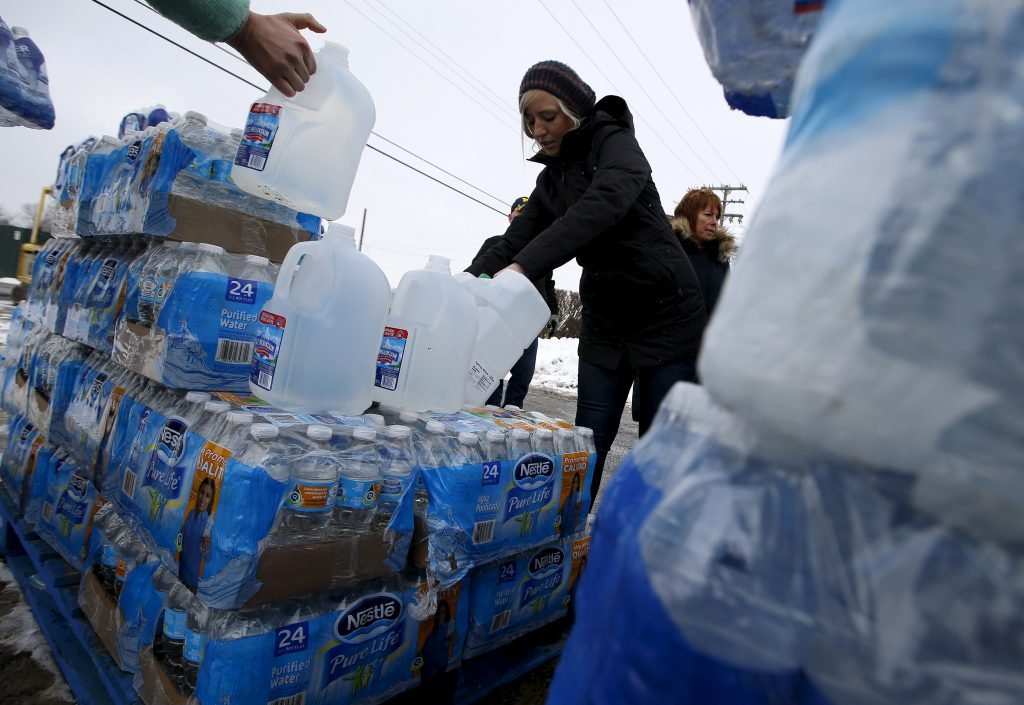
In Flint, it took approximately 11 months for federal and state governments to begin providing emergency public health services to residents; in Benton Harbor, it took 36 months.
-
Both the lead and water affordability crises have similar roots in a number of historical events. At its core, the drinking water crises in Benton Harbor are the result of racial discrimination and segregation, the familiar phenomenon of White Flight, misguided decisions by state-appointed emergency managers, and the lack of a coherent policy regarding water system regionalization.
History of Racial Discrimination and Segregation Underlies Benton Harbor’s Drinking Water Crises
The story of Benton Harbor’s Black population is a familiar one throughout the Midwest. In the 1960’s, as Benton Harbor’s Black population rapidly grew, its White population declined just as rapidly. In that decade, Benton Harbor’s White population decreased by more than 50 percent, from 14,290 in 1960 to 6,707 in 1970; during the same time, Benton Harbor’s Black population doubled, increasing from 4,846 to 9,774. This phenomenon—commonly referred to as White flight—has had long-term effects on the financial viability of Benton Harbor and its water system.Black residents coming to Benton Harbor faced discrimination in multiple facets of life. In housing, the Benton Harbor Housing Commission segregated public housing by operating one housing project for Black residents and another for White residents. It also refused admission to Black veterans to its veterans housing project solely on the basis of race. Racial segregation in schools was also very prevalent throughout Benton Harbor and the surrounding region. Eventually, many of Benton Harbor’s white residents segregated themselves from the City and its increasing Black population by moving to other nearby communities. The history of segregation in the Benton Harbor region persists to this day. The Niles-Benton Harbor metro area has been ranked as the fifth most segregated metro area in the country.
For Benton Harbor and its water system, these events have had two notable impacts. First, the loss of population is one of the main causes of the City’s financial distress that led to decreasing revenues and staffing cuts as discussed in more detail below. Second, Benton Harbor’s water system became more reliant on regional customers for financial viability. As discussed in more detail below, by 2010 the majority of consumers of the Benton Harbor water system were residents in neighboring communities.
Key Decisions Made by State-appointed Emergency Managers Reduced the Demand on the Benton Harbor Public Water System and Financially Crippled the Water System
White flight left Benton Harbor with a diminished tax base which created significant financial stress for the City. In response to this financial stress, both Democrat and Republican Governors appointed two emergency managers over a six-year time period under Michigan’s Local Financial Stability and Choice Act (commonly referred to as Michigan’s Emergency Manager Law). This law grants the State the authority to appoint emergency managers to oversee cities after the state has made a determination that a local government has “probable financial stress.” Emergency managers—which are, by statute, solely appointed by the Governor—are essentially granted complete power over the local government. The decisions of the State-appointed emergency manager override those of any locally elected officials.In Benton Harbor, the emergency managers made staffing cuts at the Benton Harbor water treatment plant, canceled water sale contracts, and sold off a significant portion of the water distribution system, all of which imperiled the water system’s long-term financial health and its ability to provide safe water to residents.
State-Lended Money for Upgrades to Benton Harbor Water System to Better Meet Regional Needs While Authorizing Benton Charter Township to Build Its Own Water System
Through the early 2000s, the City’s water treatment plant provided on average about seven million gallons of water per day (MGD) of treated drinking water, but in 2011, the City finished a $12 million upgrade to its water treatment plant that increased its treatment capacity to 12 MGD. The project was funded by loans from the Michigan Drinking Water Revolving Loan Fund and funding from the federal American Resources and Recovery Act.
However, due in large part to White flight, the remaining Benton Harbor residents required much less water compared to the available treatment capacity of 12 MGD: an average of 1.385 MGD and a maximum of 2.463 MGD. By 2011, the neighboring communities and local businesses made up more than half of the consumer base for the Benton Harbor water system. Benton Charter Township, which had an agreement to purchase water from Benton Harbor since 1968, was the consumer of roughly 40-50% of the water produced by Benton Harbor. Additionally, St. Joseph Charter Township and local businesses such as Whirlpool also had contracts to purchase water from the Benton Harbor water system.
The additional capacity of the newly upgraded Benton Harbor water treatment plant was largely obsolete the minute it was finished. In 2011 and 2013 respectively, Benton Charter Township and St. Joseph Charter Township stopped purchasing water from Benton Harbor, which drastically reduced water demand and revenues. Instead, Benton Charter Township received 16 federal, state, and local permits to construct its own 3 million gallon per day water treatment plant, costing a total of $22 million. St. Joseph Charter Township decided to purchase water from the City of St. Joseph, ending its contract with Benton Harbor. Additionally, Benton Harbor’s emergency manager sold off the portion of the drinking water distribution system that ran to the Whirlpool headquarters to Benton Charter Township, allowing the newly constructed water system to sell water to Whirlpool instead of Benton Harbor.
In Benton Harbor, the loss of these essential water sale contracts resulted in a water treatment plant treating a smaller volume of water with increased operating costs for a smaller customer base whose median income is less than half of the national average. In other words, the costs of treatment and plant operations began outpacing the revenue collected. All told, the loss of the nearby communities and local businesses as customers resulted in a reduction in revenue of approximately $2.5 million annually at a time when Benton Harbor had just taken out loans from the State to fund a $12 million upgrade to its water treatment plant to meet the surrounding communities’ water needs. Today, Benton Harbor’s water system has an annual revenue shortfall of $2.5 million annually. That revenue deficit is at the heart of Benton Harbor’s growing water affordability crisis.
The reduction in water customers and operators worked together to degrade water quality, creating a public health crisis. With a distribution system capacity designed to deliver water to a much larger population, treated water degraded during prolonged travel times to the reduced customer base. The increased water age contributed to many water quality risks including microbial growth, disinfection byproducts, and increased corrosion.

Today, Benton Harbor’s water system has an annual revenue shortfall of $2.5 million annually. That revenue deficit is at the heart of Benton Harbor’s growing water affordability crisis.
-
A Technical Managerial and Financial Study Report (TMF Report) published in 2023 highlighted the significant financial distress of the Benton Harbor water system due to shortsighted decisions by state-appointed emergency managers and the loss of regional communities as wholesale customers. Today, the current operating expenses for Benton Harbor’s water system outpace its expected revenues by $2.5 million. According to the TMF Report, the City’s water system will have a $47,000,000 deficit in just nine years if it does not receive any additional funds from the State or federal government or raise water service rates.
The source of the deficit is primarily operation and administration costs. A variety of expenses contribute to the annual operating deficit, including approximately $1.4 million for administration, $1.35 million for water treatment, $687,000 for legacy pensions, $600,000 for debt servicing, and an estimated $389,000 in unpaid water bills.
The fact that the City is not receiving an estimated $389,000 due to unaffordable water bills demonstrates the urgent need for State funding to ensure water affordability, but also the severity of the water system’s deficit. Even if all Benton Harbor residents paid their current water bill, the system would still have an annual deficit of over $2 million. Further raising customer rates is also untenable for customers because rates would have to be raised over 20 percent annually until 2032 to cover the deficit. It is estimated that this increase in rates would cause the average water bill in Benton Harbor to increase from $42 per month to $272 per month. Given that the median annual household income in Benton Harbor is $24,549, such a severe increase would require the average household to pay over 13% of their income on their water bill—over five times above the EPA’s water affordability threshold of 2.5% of household income. However, nearly 70% of Benton Harbor households earn less than the median annual household income. As such, if the projected rate increases are implemented, most Benton Harbor households will spend anywhere from 15% to 30% or more of their income on their water bill.
The severity and nature of the revenue deficit present challenging problems for Benton Harbor. A sizable portion of the deficit are the operating costs for Benton Harbor’s water treatment system and it’s clearly not feasible to eliminate the deficit by increasing rates without creating a severe water affordability crisis. However, there is also no clear source of federal or state funding to cover operating costs. Benton Harbor’s problem is fairly simple: it has lost too many customers for its current water treatment plant to remain financially viable. The solutions are more complicated: either find a significant number of new customers, drastically restructure the water treatment plant to minimize operation costs while also maintaining water quality, or purchase water from another water system. Given these significant challenges, while Benton Harbor plans to connect to St. Joseph water in late 2024 on a supposedly temporary basis as it repairs its water filtration plant, there’s a chance this temporary connection becomes permanent.

Without significant state or federal funding, customers would be required to pay over 13% of their income on their water bill—over five times above the EPA’s water affordability threshold of 2.5% of household income.
-
After the Flint water crisis, both the federal and state government took a slew of policy actions. The aim of these policies was to both prevent a similar crisis from occurring again and to make sure that the government was able to respond more urgently to the public health impacts if it did. These policies included:
2016 - U.S. EPA Creates Policy on the Elevation of Critical Health Issues: After the Flint water crisis, the EPA enacted its elevation policy which instructed staff to elevate issues that may pose significant public health risks.
2018 - Revised Michigan Lead and Copper Rule: The revisions made Michigan’s regulation more stringent than what is required by the federal Safe Drinking Water Act and were widely regarded as the strongest lead in drinking water regulations in the nation at the time they were passed.
2019 - Governor Whitmer Signs Executive Order 2019-02: Rebranded the Michigan Department of Environmental Quality as the Michigan Department of Environment, Great Lakes, and Energy (EGLE) and created the role of the Clean Water Public Advocate and the Office of the Environmental Justice Public Advocate.
2020 - 2022 - EPA first proposed a revised Federal Lead and Copper Rule in 2020, which largely missed the mark. It subsequently indicated intentions to propose additional revisions to further strengthen the rule.
Unfortunately, these policies did little to prevent the Benton Harbor water crisis or to ensure that Benton Harbor residents received public health protections once it began. Instead, similar to Flint, the State and federal governments only began to implement robust public health protections after a group of drinking water advocates filed a petition for emergency action in the fall of 2021 with the EPA.
EGLE Misses Early Opportunities: Benton Harbor’s Ticking Time Bomb and the Role of Sanitary Surveys in Proactively Addressing Lead Issues
While Michigan enacted the nation’s strongest Lead and Copper Rule in 2018, that rule still left significant gaps. One of the most glaring gaps is that systems that serve less than 50,000 people are not required to implement corrosion control treatment to limit the corrosion of lead pipes until after they exceed the lead action level. However, properly selecting optimal corrosion control treatment can take over a year and then – once that treatment is introduced to the water system – it can take over a year to lower lead levels. When it comes to lead in drinking water, there is often no quick fix. As such, it is essential for water systems and EGLE to proactively identify and address lead risks before they become a full blown crisis.The Federal Safe Drinking Water Act requires state drinking water regulators to conduct sanitary surveys of all water systems on a regular basis. The purpose of that survey is to evaluate the adequacy and condition of public water supplies. While the 2018 sanitary survey conducted by EGLE identified lead as a potential issue, it did not provide recommendations aimed at ensuring Benton Harbor was proactively addressing the problem. It stated that the “presence of lead in the distribution system is notable” and that the majority of service lines contained lead. Regarding corrosion control treatment, the sanitary survey recommended that the City continue to optimize the treatment system and the distribution system operation to minimize lead releases, but failed to note that the City was not utilizing any treatment to prevent the corrosion of lead pipes at the time.
Given the complete lack of corrosion control treatment and the significant amount of lead in Benton Harbor’s water distribution system, Benton Harbor was a ticking time bomb for a lead crisis. It was not a matter of if it would occur, but when. Given this reality, it’s alarming that the risk of a lead crisis in Benton Harbor was not proactively identified and addressed by EGLE. The Michigan Safe Drinking Water Act gives Michigan the broad authority to both notify water systems of changes it needs to make to ensure it is providing safe water to residents and, if necessary, order water systems to make changes necessary to protect the public health. Instead of taking such a proactive approach, EGLE followed the letter of the Michigan Lead and Copper Rule and waited for lead levels to spike in Benton Harbor before taking action.
Missteps in the Selection and Introduction of Corrosion Control Treatment In Benton Harbor
Once the Benton Harbor water system was required to implement corrosion control treatment after it exceeded the lead action level, the process EGLE used for selecting and implementing corrosion control treatment ran afoul of EPA guidance. When a water system that is not utilizing any corrosion control treatment exceeds the lead action level, the state must make a choice:It must either designate optimal corrosion control treatment, or;
It must require the local water system to conduct a study to gather more information before it designates the optimal corrosion control treatment.
The EPA has issued guidance to assist states with making this decision. Relevant to Benton Harbor, that guidance recommends the following:
If a water system has lead service lines, the state should require the water system to conduct a corrosion control study;
Water systems seeking to utilize blended phosphates as a corrosion control treatment should do so with caution and, if used, states should require a demonstration study, additional monitoring, or both.
As described below, EGLE failed to follow the EPA guidance highlighted above both in regards to the timeline for the corrosion control study and the implementation of the corrosion control treatment.
While Benton Harbor was required to conduct a corrosion control study, this study was not completed until the summer of 2022—well beyond the deadline established by both the Michigan Lead and Copper Rule (January 1, 2021) and Federal Lead and Copper Rule (June 30, 2021).
Despite Benton Harbor’s corrosion control study being delayed beyond the deadlines required by the rules, EGLE authorized the introduction of a blended phosphate treatment to the water system with the hopes that it would reduce lead levels in the water system while it waited for the results of the corrosion control study. EGLE initially took charge of corrosion control treatment when it approved the City’s request in 2019 to use a corrosion inhibitor feed system at the water treatment plant. The selected treatment was a proprietary blend of 70% orthophosphate and 30% polyphosphate (70/30 OPP) (a blended phosphate) intended by the manufacturer to provide corrosion control to a drinking water system. Then, in February 2020—just a year after EGLE approved the 70/30 OPP treatment—EGLE directed the City to change the plan to a product with a minimum of 90% OPP. There were numerous problems with this approach.
EGLE authorized Benton Harbor to utilize a blended phosphate corrosion control treatment, despite EPA guidance noting that such a treatment should be used “with caution” because it may not be effective in controlling corrosion in certain water systems, especially those with lead service lines. As such, the EPA recommends that if a water system uses a blended phosphate, it should perform a demonstration study, additional monitoring, or both. According to the EPA Guidance Manual, “Polyphosphates, which are polymers containing linked orthophosphate ions in various structures, are used mainly for sequestering iron and manganese. They work by binding or coordinating the metals into their structures so they cannot precipitate on sinks or clothes. Polyphosphates can also sequester lead and copper, keeping them in the water and actually increasing the risk of exposure.” The introduction of the original blended phosphate treatment was based on the recommendation of a company that proposed to utilize its own proprietary phosphate blend. There was no analysis or reasoning to justify why this corrosion control treatment was the optimal treatment for Benton Harbor. No iron or manganese data was presented that might have justified the recommendation.
After using the corrosion control treatment for a year, EGLE ordered Benton Harbor to amend its corrosion control treatment. This was problematic for the City because it was operating under the impression that it would take at least 18 months of using the 70/30 OPP blend to achieve full and expected results.
Scientific Consultant Involvement with Corrosion Control Treatment
The involvement of Cornwell Engineering at key decision points throughout the corrosion control optimization study and assessment process raises issues of impartiality and accuracy throughout the process. From early 2020 through the end of 2022, Cornwell Engineering oscillates between serving as a consultant to EGLE and contract awardee for the City.As early as February 2020 and March 2020, EGLE consulted Cornwell engineering for a professional opinion on the Benton Harbor corrosion control treatment issue. See Exhibits A, B, and C. In April 2020, EGLE staff recommended the City complete a pump test, and mentioned Cornwell’s continued ability to assist with a corrosion control study. See Exhibit D. In January 2021 EGLE awarded Cornwell Research Group a $50,000 contract to provide consultation to the State for corrosion control within the field of drinking water.
To address EGLE’s requirement to shift treatment approaches, the City issued a request for proposal (RFP) in April 2021 for a contractor to perform a corrosion control study, and later added an Addendum to the RFP on the implementation of the new corrosion control treatment approach. See Exhibit E. The City received three proposals in response to the RFP from the following three companies: Cornwell Engineering, Black & Veatch, and Metro Consulting Associates. See Exhibits E, F, and G. The proposals were sent to a scoring committee composed of two representatives from EGLE, one representative from F&V Operations, and a representative from Abonmarche. See Exhibit E.
While Black & Veatch raised concerns regarding the $50,000 budget for the RFP, the City selected Cornwell Engineering for the corrosion control treatment study work and executed the contract on July 27, 2021. See Exhibit H. On September 16, 2021, Cornwell submitted the Corrosion Optimization Study to EGLE. See Exhibit I. On November 23, 2021, EPA sent a comment letter to EGLE with feedback on Cornwell Engineering’s Corrosion Test Plan in which EPA offered to provide assistance analyzing the pipe scale. Cornwell Engineering submitted the Lead Solubility Study Summary on June 23, 2022. As described in a Benton Harbor Corrosion Optimization Engineering Memorandum submitted by Safe Water Engineering, both EGLE and EPA provided comments on the corrosion control study plan and no evidence has been provided that these concerns were ever addressed. See Exhibit J.
Using the same expert to address different levels of the analytical process—especially one that directly impacts human health—is a problem. By relying solely on Cornwell Engineering and the Cornwell Research Group, which both rely on the same principal technical expert, EGLE removed the step of peer review or quality control. A second, or neutral, scientific opinion should have been provided by a separate consultant or expert within the state government to help confirm whether the best available science was being followed throughout the decision-making process. Using the same expert that was on call for EGLE as a consultant and was awarded the contract for work by the City raises questions of impartiality. It also calls into question whether the issue has been properly addressed. The fact that Black and Veatch questioned whether the $50,000 budget would be sufficient to address the problem, further raises doubts about the effectiveness and impartiality of the consultant chosen. When there is one voice in both the role of consultant and evaluator, instead of consulting different perspectives, there is cause for concern that the end result was not the product of a scientific consensus. In this case, other experts in the field voiced their concerns through RFPs but were never consulted, and concerns raised by EPA and EGLE were never addressed. Finally, questions raised by external experts were never answered. See Exhibit J. There are many concerning issues presented in the Cornwell Corrosion Control Study, and it is unfortunate to see this in a study that had more EGLE and EPA involvement than the average corrosion control study.
Finally, the current status of corrosion control treatment in Benton Harbor is unclear. It is not clear whether the final recommendations in the June 2022 report were implemented or if a different strategy was used. Corrosion control continues to be an important lead risk reduction strategy even after lead service lines are removed because lead remains present in household fittings and fixtures in the form of galvanized steel pipes, brass fittings and fixtures, and lead solder. Appropriate use of ongoing corrosion control treatment is critical to public health protection in Benton Harbor, and the status of treatment should be easily obtained by residents.
Multiple Levels of Government, Law, and Policy Failed to Protect Benton Harbor Residents Once the Lead Crisis Began
As discussed above, shortly after the Flint water crisis made national headlines both the federal and state government took policy actions to ensure agencies more urgently responded to similar public health crises. This makes it even more shocking that less than five years after the Flint water crisis began, Benton Harbor residents had to wait longer for the robust, public health focused response to their lead crisis.The Governor’s Efforts to Reorganize EGLE in Part to Prevent Another Water Crisis Did Not Serve to Protect Benton Harbor Residents
Soon after assuming office, Governor Whitmer signed Executive Order 2019-02. The Order rebranded the Michigan Department of Environmental Quality as EGLE, and shook up Michigan’s principal environmental agency with the expressed purpose of ensuring all Michiganders have safe drinking water. In discussing the Order, Governor Whitmer made clear that the Order’s purpose was to rectify the errors made by the Michigan Department of Environmental Quality during the Flint Water Crisis, restore the public’s trust in the agency, and to ensure it is better able to serve its key role of protecting the environment and the public health.There was clearly a need to rebuild trust in Michigan’s principal environmental department after the Flint Water Crisis. In Benton Harbor, a survey of residents found their trust in their state and local leaders to provide safe drinking water was low—less than half of Benton Harbor residents surveyed said they “completely” or “somewhat” trust their state and local governments to give them information regarding the quality of their tap water.
The Governor’s Order created the position of Clean Water Public Advocate, whose role is to investigate concerns related to drinking water and to establish a statewide uniform reporting system to collect and analyze complaints about drinking water quality. The Executive Order also created the Office of the Environmental Justice Public Advocate, whose role is to investigate complaints related to residents who face discrimination based on factors such as race or income regarding environmental issues.
This reorganization and Executive Order 2019-02 plainly failed Benton Harbor residents during their time of crisis. Even with the order, Benton Harbor residents were subjected to higher levels of lead contamination for at least three years before federal, state, and local governments stepped up their response and addressed the public health impacts of the drinking water crisis. In Flint, federal, state, and local governments declared a state of emergency and began implementing a robust, public health focused response approximately 11 months after first learning of high levels of lead. Benton Harbor residents waited three years for a similar response.
In the preamble of Executive Order 2019-02, Governor Whitmer noted that government agencies can be “overly bureaucratic organizations” that “can hinder the state’s response to threats to the environment and public health and detract from good government.” Even with this recognition, unfortunately, the reorganization of EGLE did not work to improve the state’s short-term, public health response to another drinking water crisis in Michigan.
Similarly, EPA’s Elevation Policy Did Not Work to Ensure a Robust Public Health Centered Response to Protect Benton Harbor Residents
After the Flint Water Crisis, the EPA issued its own Elevation Policy. Similar to Executive Order 2019-02 signed by Governor Whitmer, the Elevation Policy instructed EPA staff to view issues through a “broader lens and to consider whether focusing too narrowly on legal, technical or protocol issues or concerns could miss opportunities to heighten public awareness of potential risk, or worse, would mean our silence in the face of potential threats to people’s health.” Specifically, the Elevation Policy encourages EPA staff to elevate issues that have the following characteristics:There appears to be a substantial threat to public health;
EPA is or can reasonably be expected to be a focus of the need for action;
Other authorities appear to be unable to address or unsuccessful in effectively addressing such a threat;
Recourse to normal enforcement and compliance tools is not appropriate or unlikely to succeed in the near time;
High and sustained public attention is possible.
In a recent report issued by the EPA Office of Inspector General, it concluded that while the Benton Harbor Water Crisis met four out the five elevation criteria, EPA staff overseeing Michigan did not use the policy to alert the Office of the Administrator to the human health risks facing Benton Harbor residents. EPA has argued it did elevate Benton Harbor concerns to agency leaders pointing to a visit from former EPA Administrator Andrew Wheeler in 2020 to announce a $5.6 million grant for lead service line replacements. However, it’s clear that the Elevation Policy did not produce an improved public health focused response from the EPA, particularly in the early days of the Benton Harbor water crisis. Simply put, a press conference from the EPA Administrator announcing a federal grant was not the kind of robust and urgent response that Benton Harbor residents needed and deserved.
Government Transparency was Lacking, Especially Around Issues not Raised in the Petition
After the September 2021 petition focusing on publicly available information regarding lead in drinking water was filed, EGLE made Sanitary Survey inspections from 2018 and inspection reports from September 2021 publicly available. While this report primarily focuses on elevated lead in drinking water, many violations and significant deficiencies associated with the Surface Water Treatment Rules were revealed through this process as well.The violations were identified through EPA and EGLE inspections and were enumerated in the EPA’s Unilateral Enforcement Order. See Exhibit K. These violations and concerns raised about the water treatment plant were mostly identified, investigated, and addressed in secrecy. Limited documentation is available to confirm that all the mandatory steps were satisfactorily completed per the Unilateral Administrative Order. Further, the resolution of the longest duration public health violation appears to be in conflict with limited publicly available information as discussed in the Disinfection Profile and Benchmarking Report. See Exhibit L.
-
In addition to playing a significant role in Benton Harbor’s lead crisis, numerous state actors—most notably emergency managers and EGLE—have played a role in laying the groundwork for Benton Harbor’s growing water affordability crisis.
Emergency Managers’ Role in the Benton Harbor Water Affordability Crisis
Benton Harbor emergency managers made key decisions that have shaped the current state of Benton Harbor’s water system. These decisions not only laid the groundwork for the lead crisis, but the growing water affordability crisis as well.
Michigan urgently needs a comprehensive and durable policy regarding regional planning for drinking water services. However, it also must ensure this policy not only acknowledges long-term societal factors such as racial discrimination and segregation that have imperiled water systems in communities of color and also acknowledges the State’s role in facilitating Benton Harbor’s affordability crisis. Otherwise, the regionalization of water service will only serve to further entrench racial inequities.
The roots of the State’s role in the lead crisis can be pinned on emergency management, which drastically cut the Benton Harbor water system’s staff from ten employees to six employees. Emergency managers also made decisions that have helped create the water quality and affordability crisis, as they were responsible for selling portions of the water distribution system and canceling contracts to commercial customers such as Whirlpool. As discussed above, the financial health of the Benton Harbor water system is largely dependent on being a regional system that sells water to businesses and nearby communities. Canceling such contracts has imperiled the long-term financial health of the water system.EGLE’s Role in the De-Regionalization of Benton Harbor’s Water System and its Growing Water Affordability Crisis
EGLE also played a key role in facilitating the growing water affordability crisis. It was responsible for issuing loans to the Benton Harbor water system to finance the $12 million expansion project while simultaneously issuing permits to Benton Charter Township to authorize construction of a new water system that would allow Benton Charter Township to cease purchasing water from Benton Harbor. In Executive Directive 2021-09, Governor Whitmer required EGLE to develop a proposal to promote regional planning to ensure the state’s infrastructure investments are equitable and result in high-quality drinking water at lower cost. But just a decade ago, EGLE did the opposite by issuing loans to Benton Harbor while allowing Benton Charter Township to construct its own water system. This debt service and the loss of regional consumers are the primary drivers of the Benton Harbor water system’s financial distress.
Michigan urgently needs a comprehensive and durable policy regarding regional planning for drinking water services. However, it also must ensure this policy not only acknowledges long-term societal factors such as racial discrimination and segregation that have imperiled water systems in communities of color and also acknowledges the State’s role in facilitating Benton Harbor’s affordability crisis. Otherwise, the regionalization of water service will only serve to further entrench racial inequities.
-
There are solutions for the Benton Harbor water crisis, including funding infrastructure improvements, changing the framing of law and policy associated with the Lead and Copper Rule from being reactive to proactive, and repealing Michigan’s Emergency Manager Law to ensure local elected leaders, not Governor-appointed emergency managers, have the power to serve the constituents that elected them.
Funding Lead Service Line Replacements in Environmental Justice Communities
While all lead service lines have been replaced in Benton Harbor, there are many environmental justice communities throughout Michigan with lead in their water distribution systems. New federal laws, such as the Infrastructure Investment and Jobs Act (IIJA), and existing federal laws, such as the Drinking Water State Revolving Fund (DWSRF), the Community Development Block Grant Program (CGBGP), and the Water Infrastructure Finance and Innovation Act Program (WIFA), make funding available specifically for communities that are dealing with water infrastructure concerns such as lead in drinking water. IIJA, passed in November 2021, invests $15 billion in lead service line replacements. Additionally, President Biden’s Justice40 Initiative ensures that 40% of federal investments will go to communities that are overburdened by pollution and considered ‘disadvantaged.’ This includes investments in the development of critical clean water infrastructure.State leadership also has raised funds for lead service line replacement. Governor Whitmer’s accomplishment of nearly replacing all lead service lines in Benton Harbor within 18 months of Michigan elevating its response to the crisis is significant. To prevent future drinking water crises, Michigan must continue to provide grant funds to local communities for the replacement of lead service lines. Given Michigan’s history of struggling to respond to lead crises in communities of color, it should prioritize its funds for such communities, which is also consistent with Justice40.
The Michigan Department of Health and Human Services Should Establish Standard Protocols for Providing Public Health Services to Communities That Have Lead in their Drinking Water
One notable gap in the lead and copper rule is its silence about what state and local governments must do to ensure that local residents have safe drinking water in the short term if it is discovered that lead is present in the drinking water system. As a result, the extent of public health services residents receive often varies based on how much pressure residents can bring to bear on State and local officials. This is evident in Benton Harbor, where residents lived with high levels of lead for much longer than Flint residents before receiving comparable public health services, and those health services only came about after a group of local and drinking water advocates petitioned the EPA for emergency action.Michigan should create a standard protocol for State and local governments regarding the public health response to lead action level exceedances that proactively engages community members in the response. This protocol should identify best response practices, including what types of public health resources will be made available to residents to mitigate their exposure, such as the provision of water filters and/or alternative sources of drinking water, and get other monitoring and health services related to lead exposure, such as providing pre-mixed baby formula to residents.
Enhance EPA Oversight and Assistance in Environmental Justice Communities.
Despite enacting its Elevation Policy shortly after the Flint Water Crisis, the EPA didn’t meaningfully engage in Benton Harbor until after a group of drinking water advocates petitioned the EPA urging it to become more involved. While the EPA Administrator did visit Benton Harbor to announce the grant of federal funds to assist with lead service line replacement, this did nothing to ensure Benton Harbor residents were receiving safe drinking water in the near term.Early EPA involvement could have made a significant difference in outcomes in Benton Harbor. It appears that EGLE was failing to follow EPA guidance regarding the introduction of a corrosion control treatment that the EPA warned should only be used with caution. If the EPA had been more involved from the start, it could have provided more guidance to EGLE and Benton Harbor sooner on this issue.
While the Elevation Policy commits EPA to elevating issues internally, it does not provide clarity as to when EPA will step up its involvement on a given issue and coordinate with State environmental departments to institute a more robust, public health-focused response. The Elevation Policy should clearly describe a decision-making protocol for such situations. Additionally, Elevation Policy should commit the EPA to utilizing key environmental justice principles, including acknowledging the right of residents in environmental justice communities to participate as equal partners in decision-making through meaningful engagement with the EPA when it identifies issues that may warrant the implementation of its Elevation Policy.
EGLE Should Identify Communities At-Risk of Lead in Drinking Water and Require or Incentivize Proactive Measures to Protect Against the Next Lead Crisis
As mentioned above, given the prevalence of lead throughout Benton Harbor’s drinking water system and the fact that it was not utilizing any corrosion control treatment, it was just a matter of time before the City experienced a lead action level exceedance. Once it did, identifying and implementing the proper corrosion control treatment—even if done perfectly—would have taken at least a year or two leaving residents with unsafe drinking water for an extremely long period of time.
Rather than wait for the next crisis, EGLE should identify which communities are most at-risk of lead contamination in drinking water and either require or incentivize them through their Drinking Water State Revolving Fund program to proactively address the risk through both lead service line removal and implementing or updating corrosion control treatment. This should be a priority for future sanitary surveys conducted by EGLE. Communities can be prioritized by the total number and percentage of lead service lines reported through the preliminary Distribution System Materials Inventories required in the 2018 Michigan Lead and Copper Rule.Improve Transparency and Publicly Available Information
Throughout the Benton Harbor Water Crisis, the Benton Harbor Community Water Council and supporting organizations have repeatedly asked for improved transparency from both EGLE and the EPA. Despite calls for open, community-led meetings with appropriate technical experts and decision-makers, these were never provided. Further, the groups sent several inquiries about the status of programs, water quality changes, and compliance information, but responses were never provided. The following is a list of communications for which drinking water advocates are still awaiting acknowledgment and responses:August and July 2022 re: Lead Service Line Replacement procedures
July 22, 2022 letter to Regina Strong, EGLE Environmental Justice Public Advocate
July 28, 2022 re: Point of Use Water Filters in Benton Harbor
July 29, 2022 re: Clarifications on the June 3 Benton Harbor Presentation and June Public Notices
October 28, 2022 letter re: Correspondence regarding the EGLE and MDHHS response to the Benton Harbor Water Crisis
December 20, 2022 letter re: Filter Urgency in Benton Harbor
January 11, 2023 letter re: Benton Harbor Corrosion Optimization Engineering Memorandum
September 25, 2023 letter re: Disinfection Profile and Benchmarking Study
During a water crisis, it is essential for information to be readily available to the impacted community. No community should ever be left unaware that there is lead in their drinking water and/or forced to beg for timely information about water quality and the status of the government’s ongoing response. Public health protection for the community should be the guiding principle for all communications during a drinking water crisis. Requests for information from the community must be acknowledged and responded to as quickly as possible. Education to all community members is key to protecting resident’s health while solutions are being implemented. New policies are needed going forward to prevent residents from having to wait for answers to their pressing questions about their health and communities years once an issue is identified. There is no safe level of lead in drinking water, and residents in affected communities need to know whether their water is safe to drink and when exactly the problem will be fixed.
The Environmental Justice Public Advocate held regular meetings in Benton Harbor, but they were not public nor led by the community consistent with Environmental Justice principles.
As discussed more fully in an American Water Works Association Journal article, “[r]esidents need a designated space to engage with their water utility and elected officials. Resident-led meetings are important opportunities to build relationships and trust with decision makers. Water utility, elected official, state regulator, and health and human services staff should organize and participate in these community meetings, but they need to emphasize resident participation and community-led agendas. In addition to sharing the city or water department’s response, these meetings should be a space for community members to ask questions, learn about the planned response, and share their observations and actual experiences so that processes can be adapted and improved. Compliance and response data should be shared with full transparency so that consumers can ask questions when the experts are in the room.”Policy Changes Relating to the Lead and Copper Rule
Zero ppb is the safe level of lead in drinking water as defined by EPA. The federal lead and copper rule must be improved to ensure it prevents and/or rapidly addresses a similar drinking water crisis. Moving forward, policy should shift from reactively responding to lead in drinking water to proactively eliminating lead in drinking water. This shift can occur by focusing on the following policies: (1) requiring that water systems comply with a maximum contaminant level of 5 ppb; and (2) requiring water systems to completely replace all lead service lines.Repeal the Emergency Manager Law
The State of Michigan should repeal the Local Financial Stability and Choice Act, the law authorizing the Emergency Manager legal framework. This Act authorizes the state government to forcefully impart its will on a local government by taking away local elected leaders’ legal authority to make decisions without considering impact on public health or long-term financial stability. The decisions of emergency managers in Flint and Benton Harbor to cut costs in the short-term have caused or significantly contributed to the drinking water crises and public health impacts in both cities. Further, both cities have struggled to make water service affordable after their respective drinking water crises. In short, emergency management did nothing to prevent both a public health and financial crisis regarding Benton Harbor’s water system. If anything, decisions made by emergency managers caused or, at a minimum exacerbated, both crises. The Local Financial Stability and Choice Act should be repealed.
-
Alleviating the drinking water affordability crisis in Michigan, in particular Benton Harbor, will not only require additional federal and state financial assistance to fund capital costs but also operation and administration costs. Additionally, given the growing water affordability crisis, Benton Harbor must take steps to ensure drinking water remains affordable for all residents as it confronts the water system’s revenue deficit.
The Federal and State Government must Provide Adequate Funding to Address Benton Harbor’s Growing Water Affordability Crisis
The warning from the TMF Report regarding the Benton Harbor water system’s annual revenue shortfall is stark. The water system has an annual revenue deficit of $2.5 million. In order to cover the deficit through rates, Benton Harbor must raise the cost of water service by 20 percent annually over the next nine years. Such a dramatic increase would make water bills unaffordable for even the average Benton Harbor household, but for lower income households it would be even more devastating. While the lead service lines have been removed from Benton Harbor’s water system, drinking water is already unaffordable for many Benton Harbor residents and will become increasingly unaffordable for most Benton Harbor residents absent federal or state financial aid.
As highlighted above, the federal and state governments all played a role in allowing the Benton Harbor water crisis to unfold. The EPA failed to follow its Elevation Policy which was enacted after the Flint Water Crisis to prevent such disasters from happening again. Various governors in Michigan appointed emergency managers that canceled water sale contracts and cut staff at the water treatment plant, jeopardizing the technical, managerial, and financial sustainability of the water system and its safety. Michigan approved loans to upgrade Benton Harbor’s water system to better meet the needs of neighboring communities while also allowing other communities to build their own water system. The reorganization of Michigan’s environmental protection agency failed to prevent another drinking water crisis while work to address the Flint Water Crisis was still ongoing.
To help remedy this harm, unprecedented amounts of federal funding are available for low-income and disadvantaged communities through IIJA, and existing federal laws, such as the DWSRF, the CDBGP, and the WIFA Program, that make funding available specifically for communities that are dealing with water infrastructure concerns such as lead in drinking water. Additionally, President Biden’s Justice40 Initiative requires that 40 percent of federal investments in water infrastructure must benefit disadvantaged communities. This includes investments in the development of critical clean water infrastructure.
According to a recent report, Benton Harbor will have approximately $27 million in grant funds remaining after it completes the replacement of all lead service lines. $17.3 million will be needed for short-term capital improvements to the water treatment plant and the distribution system which could leave an additional $10 million in grant funds. However, it has also been estimated that Benton Harbor will need to spend an additional $35 million for further improvements to the distribution system over the next 20 years. Additionally, the cause of Benton Harbor’s current deficit is multi-faceted and includes not only debt servicing from previous loans for capital improvements but also operation and administration costs, including legacy pensions costs. At a minimum, the principal and any accrued interest on all existing loans issued to Benton Harbor from Michigan’s Drinking Water State Revolving Fund should be forgiven. Additionally, the City should also be given grant funds to help low-income customers repair plumbing leaks and replace old, water-guzzling toilets, which can both reduce water supply costs and provide ongoing bill reductions for customers.
The vast majority of grant programs for water systems provide funds for capital improvements to the drinking water treatment or distribution system. While Benton Harbor needs additional funds for long-term capital improvements to its distribution system, it also requires assistance to defray its operation and administration costs. Addressing Benton Harbor’s growing water affordability crisis will require both the federal and state government to think outside the box in regards to the type of aid it provides. Absent a long-term solution that reduces the operation cost of Benton Harbor’s water system or a significant increase in Benton Harbor’s customer base, the water system will not be financially viable. If Benton Harbor is unable to either reduce the water system’s operation costs or increase its customer base, the City will be forced to abandon its water treatment plant and begin to purchase water from a nearby water system.The City Should Adopt Equitable Rate Structures to Increase Revenue without Burdening Low-income Customers
In addition to securing grants, there are steps the City can take to reduce costs for low-income customers specifically through the adoption of equitable rate structures. Potential equitable rate structures include: (1) capping bills for low-income residents at a percentage of income; (2) adopting “lifeline” rates with a low charge for an initial amount of usage sufficient to meet each household’s essential needs; and (3) offering bill discounts specifically to low-income customers.

The Michigan Department of Environment, Great Lakes, and Energy should identify communities in Michigan at risk of having lead in drinking water and require proactive measures to protect against the next lead crisis.
-
After the Flint Water Crisis, federal and state governments took several steps intended to prevent similar disasters from occurring. Both the federal and Michigan governments revised their lead and copper rules. Both created new policies aimed at ensuring environmental agencies at both levels of government were able to push against bureaucratic inertia and nimbly respond to public health threats. Still, less than five years later, a disturbingly similar crisis occurred in yet another majority Black city in Michigan and this time the initial response was somehow slower, allowing the damage to the community of Benton Harbor to continue unchecked.
While it took much longer than it should have, Benton Harbor residents now have safe drinking water coming from their taps. However, another crisis is looming—many residents are already struggling to afford drinking water and that problem is projected to become much worse over the next decade unless the federal and state governments step in to address the issue. After Benton Harbor residents lived for at least three years without safe drinking water, they deserve, at a minimum, to drink their tap water without being charged excessive water rates.
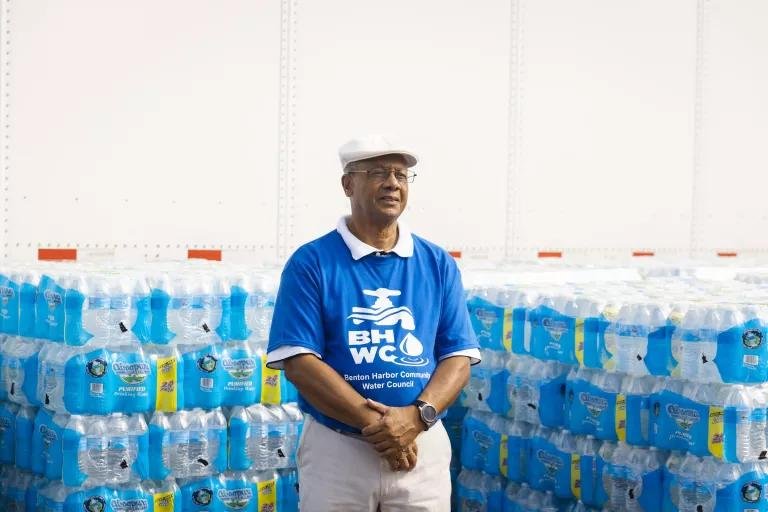
Reverend Edward Pinkney at a bottled water pickup site | Taylor Emrey Glascock for NRDC
““No community should have to worry about whether their water is safe to drink or whether they can afford to pay their water bill. This report describes what must be done to prevent future drinking water crises in Benton Harbor and across Michigan.”
- Reverend Edward Pinkney,
President of the Benton Harbor Community Water Council ”