
Identifying the Gaps: A Survey and Analysis of Community-Focused Environmental Justice Policies Across All U.S. States and Territories
A 2026 Update to Lawyers for Good Government's Disadvantaged Communities Report
Table of Contents
Defining Disadvantaged Communities at the State Level
A. Comprehensive Definitions with Wide Scopes
B. Simple and Straightforward Definition
C. Example Definitions Useful for Purple States or Split Governments
Disadvantaged Community Policies Instituted Since January 2025
Community Benefits Policies That Benefit Disadvantaged Communities
III. State-Level Findings
IV. Acknowledgements
Executive Summary
The current Administration has attempted to dismantle climate and environmental justice protections created under the Inflation Reduction Act (IRA), the Bipartisan Infrastructure Law (BIL), and other long-standing civil rights protections. The absence of federal leadership, responsibility, and accountability makes state- and territory-level protections for disadvantaged and similarly-defined vulnerable communities more important than ever. This Administration’s dismantling of federal disadvantaged community policies, such as the Justice40 Initiative’s requirement that at least 40% of the overall benefits from these federal investments flow to disadvantaged communities (DACs¹) that have been historically marginalized, underserved, and overburdened by pollution, leaves states and territories as the last line of defense for policies that help vulnerable communities.
In 2022, L4GG created a 50-state dashboard of the existing state-level policies, maps, and decision-makers identifying DACs to facilitate Justice40 implementation and to assist communities and advocates in identifying state decision-makers holding the purse strings.
In 2023, L4GG updated the dashboard to include: an updated overview of the various definitions and data available for identifying DACs and environmental justice communities; all known, existing, or proposed state-level policies for Justice40 implementation; and the names and contact information for relevant state-level decision-makers and agencies regulating climate, energy, water, and infrastructure to facilitate community engagement. The accompanying report also discussed the impact of using race as a metric in the wake of the affirmative action decision, Students for Fair Admissions v. Harvard, along with example state-level policies and best practices related to community engagement, DAC definitions and mapping, and Justice40 implementation.
In 2026, L4GG updated the DAC report and dashboard to ensure the information compiled is up to date, while also expanding the 50-state dashboard. The dashboard, which previously included all 50 states plus the District of Columbia and Puerto Rico, now includes all permanently inhabited U.S. territories, including American Samoa, Guam, the Northern Mariana Islands, and the U.S. Virgin Islands. We also specifically researched any Justice40-style measures or policies that states and territories implemented after January 20, 2025 (since the administration change) and expanded our examination of state mapping resources and the factors states use when they define “disadvantaged communities” or similar terms. Lastly, we added new information around state- and territory-level policies relating to climate resiliency, disaster preparedness, and community benefits that tie those efforts in some way to DACs.
L4GG has highlighted specific state policies that can serve as good models for replication or inspiration in other jurisdictions. We have examined policies that we view as effective for their comprehensive scope, and others that are effective for their relative simplicity and straightforward parameters. We have noted policies that may be particularly effective or feasible in states with split governments (i.e., where the governor is from a different party than the majority party in the state legislature), and policies that deserve extra attention for the creative ways they seek to help DACs. We have also tracked trends across all 56 states and territories and examined the variety of factors states use to define DACs (or similar groups) and choose to include in mapping resources.
We anticipate the information provided in this report and dashboard can be used in a variety of ways. State decision-makers can use this report to consider how to define or refine state definitions of DACs or similarly-defined groups. Decision-makers can also see what other states have done since January 2025 to “fill the gap” left by the current Administration’s abrogation of its responsibility to protect vulnerable communities, and craft similar policies for their own state. Local governments and communities can use this report to determine whether they are (or should be) identified as a DAC by their state or territory, and identify the most salient opportunities to push for priority funding from the state government and ensure that benefits from such funding flow to DACs. Nonprofits and advocates can use this report to identify and determine the best entry points for advocacy.
I. Defining Disadvantaged Communities at the State Level
The State-Level Findings provide a detailed cataloging and analysis of each state or territory’s definitions, but we noticed several trends and chose to highlight various interesting and important examples of the different approaches states took when defining “DACs” or similar terms.
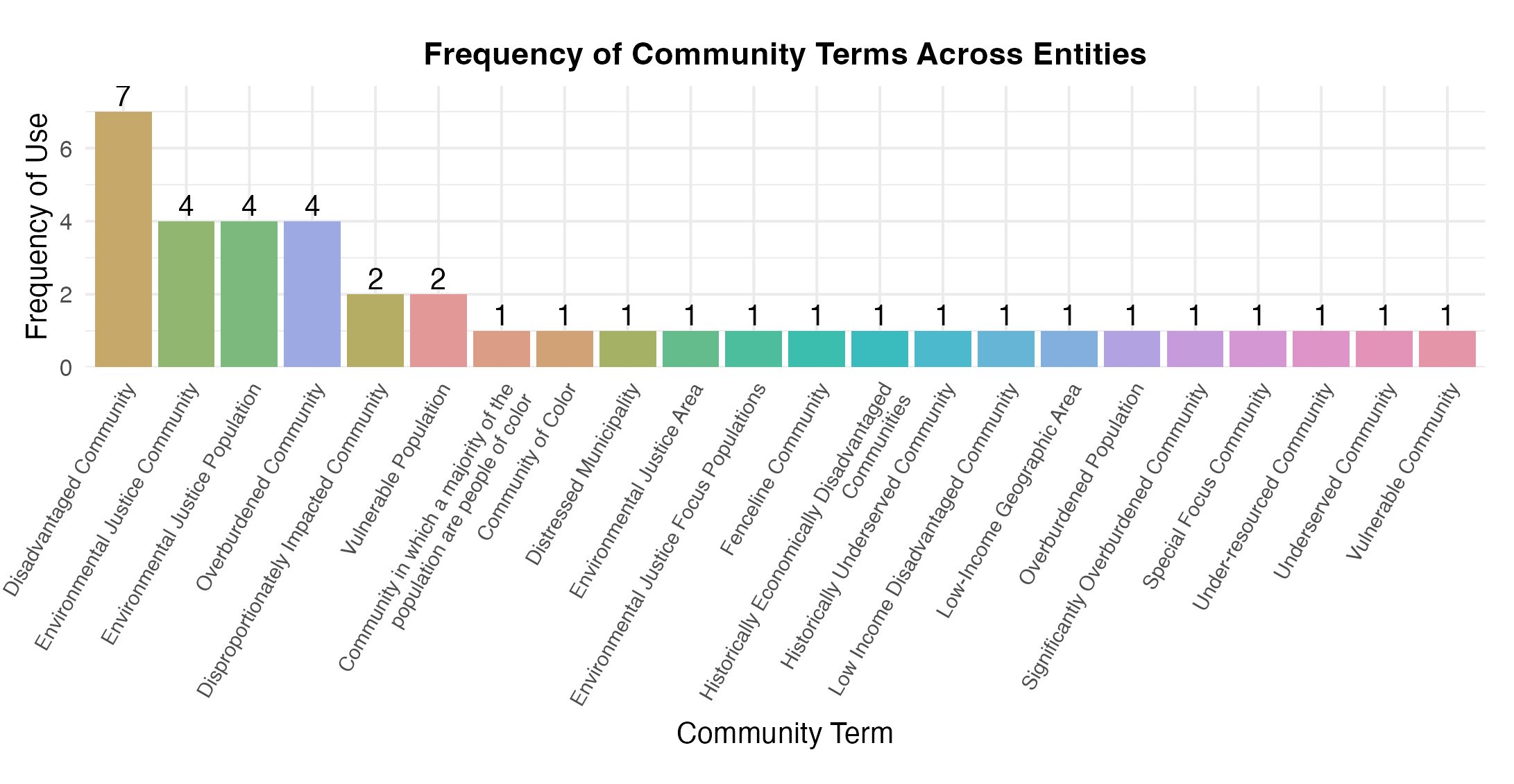
Through our research, we found that out of a total of 56² states and territories, 20 defined “disadvantaged communities” or similar terms³ in the energy and/or climate contexts through statutory or regulatory language, using a wide array of criteria. While almost all states define “DACs” in the context of clean water and drinking water, only these 20 states define “DACs” in the larger context.
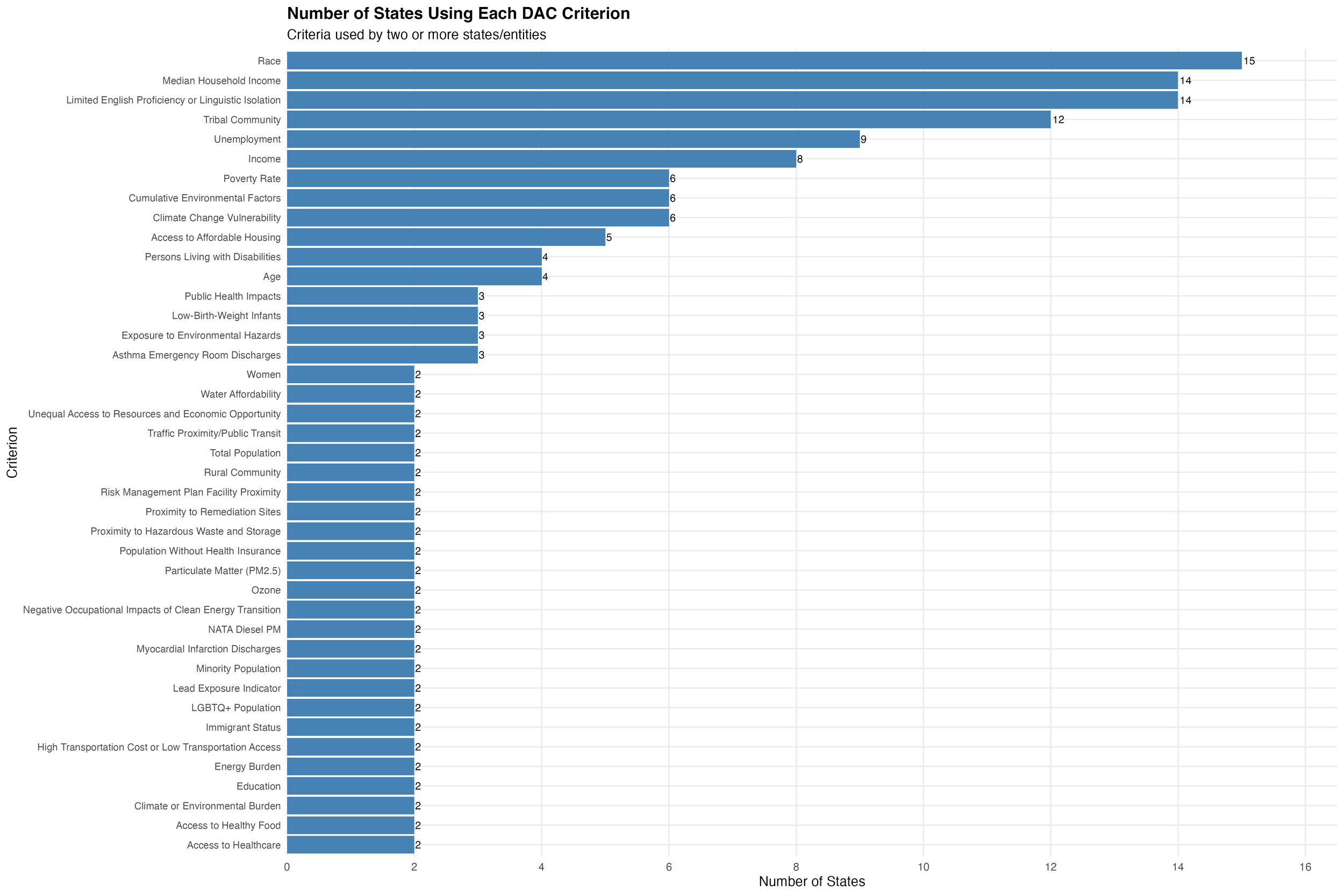
The most common factors states use to define “DACs” are income (usually measured by median household income), race, and lack of English proficiency.
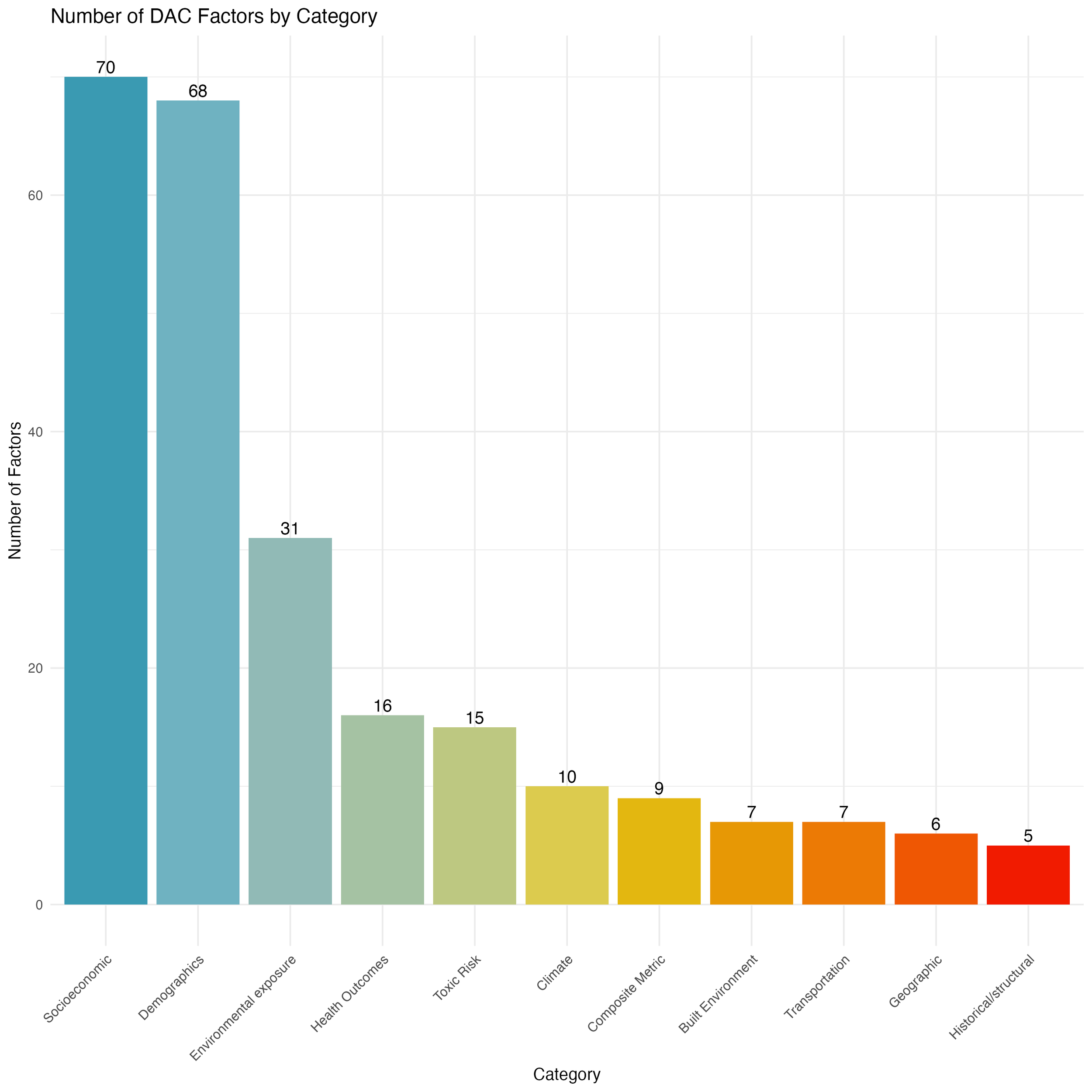
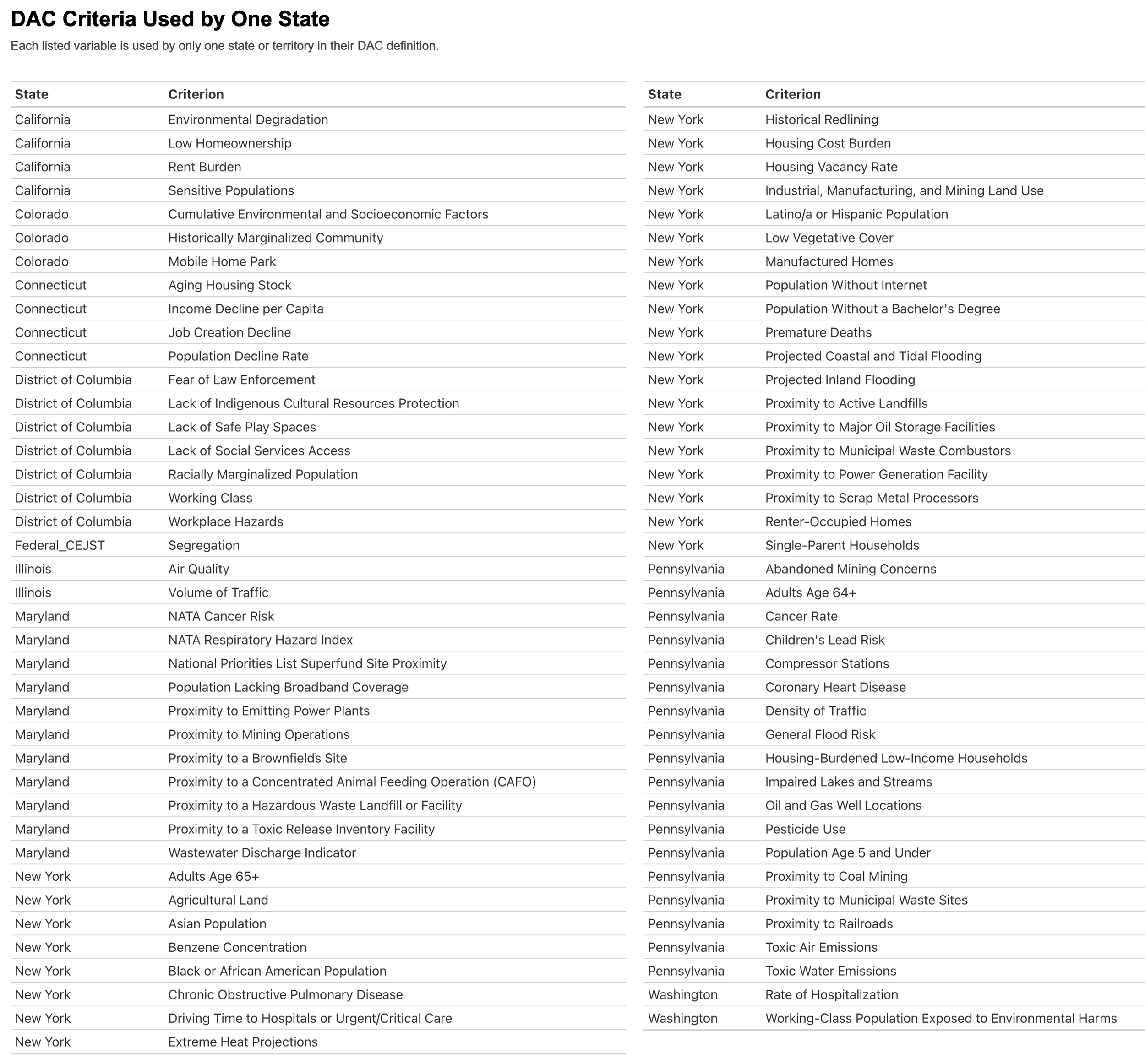
Several states used unique factors not used elsewhere, often due to specific circumstances within that state.
Hawaii uses several factors related to clean water access, water affordability, and occupational impacts from energy transition when defining DACs. Hawai‘i Climate Commission, Climate Change Social Vulnerability Framework.
Oregon is one of the few states that factors in whether communities are traditionally underrepresented in public processes when determining which communities qualify as disadvantaged. HB 4077.
Massachusetts has a “hyper local” exception in its criteria, where a portion of a neighborhood can petition to become an environmental justice population even if the overall neighborhood does not, as long as that portion meets one of the criteria and the overall neighborhood does not exceed all of the maximum thresholds on income, education, etc. Mass. Gen. Laws ch. 30, § 62.
Colorado factors in historical disparities, allowing communities to seek disadvantaged status by presenting evidence to state agencies showing a “history of environmental racism perpetuated through redlining or through anti-indigenous, anti-immigrant, anti-Latino, or anti-Black laws, policies, or practices.” Colo. Rev. Stat. § 24-4-109 (2024).
Two notable outliers: neither Rhode Island nor the Northern Mariana Islands define “DACs” or similar terms with specific criteria communities need to meet in order to be designated as such. However, Rhode Island’s Department of Environmental Management defines “Environmental Justice Focus Areas” based on median household income, race, and limited English proficiency; the Rhode Island Office of Energy Resources specifically lists 13 communities in Rhode Island that qualify as DACs. The Northern Mariana Islands considers the entire territory a DAC, factoring in the small population, the 40% poverty rate, and the heavy economic reliance on eastern tourism. Commonwealth of the Northern Mariana Islands, Recovery Plan, State and Local Fiscal Recovery Funds, 2025 Report (2025), at 7.
We are highlighting several noteworthy examples of how states have defined “DACs,” including model comprehensive definitions, a model simple and straightforward definition, and example definitions particularly useful for purple states or states with split governments.
A. Comprehensive Definitions with Wide Scopes
California: California has a comprehensive definition of DACs by taking a multi-layered and multi-faceted approach. First, through traditional legislation and statutes, California defines “under-resourced community” by incorporating separate definitions under California’s Health and Safety and Public Resources codes (Cal. Pub. Res. Code § 71130(g)), allowing communities or households to qualify as “under-resourced” based on income or various health and environmental factors.
California’s Public Resources Code (Cal. Pub. Res. Code § 71130(g)) defines “under-resourced community” by referring to definitions of “disadvantaged communities,” “low-income communities,” and “low-income households” in California’s Health and Safety and Public Resources codes:
“Disadvantaged community” is defined as:
“Areas disproportionately affected by environmental pollution and other hazards that can lead to negative public health effects, exposure, or environmental degradation” or “areas with concentrations of people that are of low income, high unemployment, low levels of homeownership, high rent burden, sensitive populations, or low levels of educational attainment” (Cal. Health & Safety Code § 39711(a)); and
“A community with a median household income less than 80% of the statewide average,” while “severely disadvantaged community” means “a community with a median household income less than 60% of the statewide average” (Cal. Pub. Res. Code § 75005(g)).
“Low-income households” are defined as households “with household incomes at or below 80% of the statewide median income or with household incomes at or below the threshold designated as low income by the Department of Housing and Community Development’s list of state income limits adopted pursuant to [Cal. Health & Safety Code § 50093].” Cal. Health & Safety Code § 39713(d)(1).
“Low-income communities” are defined as “census tracts with median household incomes at or below 80% of the statewide median income or with median household incomes at or below the threshold designated as low income by the Department of Housing and Community Development’s list of state income limits adopted pursuant to [Cal. Health & Safety Code § 50093]. Cal. Health & Safety Code § 39713(d)(2).
Second, California also enacted, via a 2024 public proposition, several different terms, including “disadvantaged communities,” “economically distressed areas,” “socially disadvantaged farmers,” “severely disadvantaged communities,” and “vulnerable populations.” SB 867. Each of these terms tracks either different factors or set different thresholds for those factors. For example, most of the different terms use income as the criteria, while “vulnerable populations” qualify through metrics tracking impacts of climate change.
California’s approach provides a framework for more targeted and equitable investments, allowing policy to follow the specific, granular definitions of DACs and be tailored for the specific needs of the variously defined communities. California’s use of public propositions to create these definitions also allows California’s definitions to better track public ideas on how to define DACs.
New York: New York also has a broad definition of “disadvantaged communities” through a three-pronged approach. Communities in New York qualify based on any of three categories of factors: (1) environmental factors that affect public health; (2) demographic factors such as income, employment, rent burden, education level, and historical discrimination based on race or ethnicity; or (3) vulnerability to climate change, through flooding, storm surges, or urban heat island effects. N.Y. Envtl. Conserv. Law § 75-0111(1)(c). New York’s approach is effective, not relying on just income or race, but rather using multiple factors that can each independently qualify a community as disadvantaged, without multiple levels or categories of disadvantaged. By defining multiple categories as “disadvantaged”, this approach covers many different communities dealing with a variety of burdens, without creating an overly complicated classification system.
B. Simple and Straightforward Definition
New Jersey: New Jersey takes a simple and straightforward approach to its definition of “overburdened community.” New Jersey looks at census block groups and uses U.S. census data, and treats as overburdened any community in which “(1) at least 35% of the households qualify as low-income households; (2) at least 40% of the residents identify as minority or as members of a State-recognized tribal community; or (3) at least 40% of the households have limited English proficiency.” N.J. Stat. Ann. § 13:1D-158 (2024). New Jersey’s simple approach using centralized data serves as a good model for states that may struggle to implement more complex definitions or criteria, for political reasons or otherwise.
C. Example Definitions Useful for Purple States or Split Governments
Our research also provided helpful examples of states that defined DACs through creative or politically useful methods. For states with split governments (i.e., a governor from a different political party than the majority party in the state legislature) or states with significant popular support for DAC policies but lackluster political support, creative methods to implement statewide definitions may be the only way for those states to implement important policies and protections for vulnerable populations.
California: As mentioned above, California implemented detailed qualification criteria for DACs through its public proposition system in 2024, SB 867. California’s example could serve as a roadmap for advocates and organizers in states with similar initiative or referendum systems—of which there are more than 20.
North Carolina: North Carolina sets its definition of “Environmental Justice Communities” as “communities of color, low-income communities, or indigenous communities that are experiencing, or are at risk of, disparate impacts as a result of the agency action under consideration.” ⁴ Executive Order 292.
Former North Carolina Governor Roy Cooper, a Democrat, served as the state's governor at a time when both chambers of the state legislature were controlled by Republicans. Governor Cooper issued Executive Order 292, Advancing Environmental Justice for North Carolina, which defined environmental justice communities, in October 2023. At the time of the Executive Order's issuance, Republicans held a supermajority and could override any veto efforts by Governor Cooper. With legislative avenues closed, Governor Cooper’s use of the executive order process was the only politically viable option remaining to legally define “environmental justice communities” under North Carolina law. While the effect of the executive order was more limited than legislatively enacted statutes would allow, the executive order option can serve as a model for states with similarly split governments.
II. State-Level Policies That Benefit Disadvantaged Communities
States have taken different approaches on how to craft state law to benefit DACs, falling across a wide spectrum from broad, Justice40-style requirements that a minimum percentage of overall benefits must flow to DACs, to vague and ill-defined directives that state agencies should develop policies that help DACs.
Despite Justice40’s dismantling at the federal level, several states have taken up the baton and set overall percentages and/or minimum requirements for funding or benefiting DACs. California requires 25% of funds to be allocated toward projects that benefit DACs, while 5% must go to projects benefitting low-income communities and households, and another 5% must go to projects benefitting communities outside DACs, but within a half mile of one. SB 535; AB 1550. New York similarly follows Justice40’s model, requiring at least 35% of the overall benefits of clean energy and energy efficiency programs (with a goal of 40%) to be directed to the benefit of DACs. N.Y. Envtl. Conserv. Law § 75-0117. Other states, like Washington, set minimum funding requirements for DACs as well, but only apply them to certain funding streams, such as Washington’s Cap and Invest Program. Wash. Rev. Code § 70A.65.
Other states create specific funds or grants for DACs, or set aside minimum percentages of those specific funds for DACs. Delaware’s Clean Water Trust supports the Delaware Clean Water Initiative, which is a plan to address the wastewater and drinking water needs of low-income and underserved communities in Delaware. 29 Del. Code § 8080–82 (2024). Colorado features a Community Impact Cash Fund, which provides grants for environmental mitigation projects in impacted communities. Colo. Rev. Stat. § 25-7-129 (2024).
Other states merely direct state agencies to develop policies and programs to assist DACs, but often lack clear directives. Maryland, through its Climate Pollution Reduction Plan, directs its Department of the Environment to target investment in clean electricity, clean buildings, clean vehicles, and clean industry in communities throughout the state, especially overburdened and underserved communities. The Massachusetts Executive Office of Energy and Environmental Affairs’ Environmental Justice Policy prioritizes underserved/DACs by prioritizing program funding to DACs and factoring in impact to DACs when making permitting decisions. Executive Office of Energy and Environmental Affairs, Environmental Justice Policy, at 13 (June 24, 2021).
Other states, including Minnesota, New York, and California, also consider impacts on DACs when making permitting decisions. California takes it a step further, requiring counties and cities in California to include an environmental justice element or related environmental justice goals, policies, and objectives as part of a required comprehensive, long-term general plan for the physical development of the county or city and of any land outside its boundaries that bears relation to its planning. SB 1000.
Pennsylvania features a unique policy that benefits DACs. The Pennsylvania Department of Environmental Protection’s Environmental Justice Policy prioritizes inspection and monitoring actions at sites in Environmental Justice Areas. But perhaps more importantly, when assessing civil penalties on regulated entities, the Pennsylvania Department of Environmental Protection factors in whether the events occurred in an Environmental Justice Area and encourages the affected municipality to direct the civil penalties received toward projects that will directly benefit the Environmental Justice Area (or allow the violator to perform remedial work in that area).
III. Disadvantaged Community Policies Instituted Since January 2025
Since the current Administration took office in January 2025, the federal government has undone or repealed most of the federal policies benefiting DACs. This abrogation of the federal government’s responsibility to protect vulnerable populations has left a gap that states can and should step in to fill.
However, few states have taken significant steps to implement Justice40-style policies. Only a handful of states have proposed legislation to address DACs (e.g., North Carolina, Washington), but have yet to see new laws enacted that protect disadvantaged populations.
Some states have instituted targeted policies that address specific issues, but lack the minimum funding levels that Justice40 required. Colorado has instituted public health and pollution mitigation programs that specifically target assisting low-income and overburdened communities. Colo. Rev. Stat. § 25-4 2203 (Health Disparities and Community Grant Program); Colo. Rev. Stat. § 25-11-114 (Radiation Mitigation Program). Maryland Governor Wes Moore issued an executive order that places numerous requirements on Maryland agencies to implement measures to support DACs and environmental justice, and promote funding opportunities for DACs, but it lacks a specific funding benchmark like Justice40.
IV. Water Infrastructure Policies
Long before the Justice40 Initiative was established, and the term “disadvantaged community” became a critical legal definition, states were required to consider affordability and other criteria for identifying underserved communities in the water context. Both the Clean Water Act (CWA) and the Safe Drinking Water Act (SDWA) include provisions to prioritize water infrastructure funding for communities in need. These frameworks, called state revolving funds (SRFs), are federal-state partnerships that provide low-cost financing and principal forgiveness to communities for certain clean water and safe drinking water-related projects. SRFs are governed by federal law, but provide states with flexibility for selecting and financing water-related projects in order to meet local needs.
Specifically, Section 603(i) of the CWA, amended in 1987, details how a state Clean Water State Revolving Fund (CWSRF) program may provide additional subsidies for communities in need and requires each state to establish affordability criteria for the program.⁵ The SDWA was amended in 1996 to establish the Drinking Water State Revolving Fund (DWSRF) program to assist with financing the costs of infrastructure upgrades to water systems to address public health needs. Section 1452(b) of the SDWA requires that each state prepare an annual Intended Use Plan (IUP) to identify the proposed use of funds in the drinking water context. 42 U.S.C.A. § 300j-12(b)(1). Section 1452(d)(3) defines the term “disadvantaged community” in the drinking water context to mean the service area of a public water system that meets affordability criteria established by each state. 42 U.S.C.A. § 300j-12(d)(3).
The Infrastructure Investment and Jobs Act (IIJA) amended the CWA and SDWA to provide an even greater subsidy for DACs through loan principal forgiveness, grants, and negative interest loans. 42 U.S.C.A. § 300j-12(d)(1)(A). In addition, the EPA previously issued guidance requiring states to define a DAC to establish a threshold for eligibility for federal subsidies under the SRF program. In response, states have been adding more specific DAC definition criteria and revising existing affordability criteria in the SRF context. States often implement these changes by providing more detailed DAC definitions in the appendix to the State’s IUP, which are revised on an annual basis.
Some notable trends and additions to the DAC definitions by states in the water context:
Several states limit their definitions of “DACs” in the water context to communities with populations of 10,000 or less (Colorado, Illinois, Wisconsin).
Several states treat smaller or more rural communities differently when examining whether they should be considered “disadvantaged.”
Arizona provides special drinking water hardship grants to rural communities that meet certain criteria.
California has a specific definition for “small disadvantaged community,” covering communities with populations below 10,000 and only requiring median household income to be 80% or lower than the statewide average to qualify for extra benefits compared to normally “disadvantaged communities.” Conversely, larger communities need to have a median household income of 60% or less compared to the state average to qualify as “severely disadvantaged.”
Delaware provides a mechanism for state agencies to separately designate a community as “underserved” based on criteria related to access to drinking water and wastewater services and whether the public water system is in violation of various contamination regulations.
Minnesota, Pennsylvania, and Vermont factor in income, like all states, but do so by comparing the annual water system cost compared to median household income, rather than comparing median household income to the state average.
While several states have yet to directly address equity in climate or energy, they have established DAC definitions and affordability criteria in the water context to secure additional funding. For this reason, the State-Level Findings include analyses for each state’s definition of affordability criteria and, if applicable, DAC criteria (or criteria for a similar term) in each state’s clean water and drinking water context.
Each state manages its SRF differently, using a unique set of laws and regulations available in state regulations, IUPs, and other guidance documents. While the State-Level Findings in this report provide a high-level overview of how each state defines its affordability criteria in the water context, practitioners should consult a state’s most recent IUP and applicable laws, regulations, and guidance documents in order to have a complete understanding of the state’s principal forgiveness financing framework (including applicable thresholds, how criteria are weighed, and the relevant formula) to determine financing eligibility for disadvantaged and overburdened communities under the SRF program.
V. Climate Resilience and Disaster Preparedness Policies
Our most recent update to the DAC Report examines how states included protections for DACs in their climate resilience and disaster preparedness policies, plans, and programs. States have different approaches for DACs in the climate resilience and disaster preparedness frameworks: some states do not address DACs at all, some institute policies that assist DACs in indirect ways (or contain policies that provide additional assistance to DACs), and some states promulgate plans and policies that specifically assist DACs. Notably, some states that do not define DACs in the climate or energy contexts do consider DACs in the climate resilience and/or disaster preparedness contexts.
We did notice some trends and throughlines in state policies. The most common contemplation of DACs we saw was consideration of DACs in the planning context: many states required agencies to build into climate action plans some additional protections or outreach to DACs. Arizona, which does not define DACs in the energy and climate contexts (beyond special designation of unincorporated rural communities on the U.S. border), uses economic factors and rural status when preparing for extreme heat events. Arizona also contemplates financial and social barriers when examining how communities can access mitigation assistance during disasters. Colorado uses granular, community-level data relating to DACs, rather than state-level data, when implementing its planning process. Minnesota funded studies for cities in the state to identify their own vulnerable populations and vulnerable individuals to direct targeted climate resiliency efforts.
Many states prioritize DACs through additional grant funding or availability. California has a specific grant program through its Office of Emergency Services aimed at building community resilience among vulnerable individuals living in areas of the state most susceptible to natural disasters and reducing long-term risks of disasters—such as flooding, earthquakes, wildfires, landslides, or dam failure—by investing in infrastructure improvements designed to protect communities. Hawaii prioritizes communities with the highest hazard mitigation needs with its Resilient Hawaii revolving loan fund. Vermont ran a program that purchased property from residents in flood-prone areas and provided specific additional measures for low-income residents; while it has since exhausted its funding, it is an example of a program that had significant positive impacts and could be replicated elsewhere.
Lastly, while few states have implemented Justice40-style minimum benefits requirements for DACs in the larger energy and climate contexts, several states set or plan to set 40% minimum benefits or funding requirements for DACs in the climate resilience context, including Connecticut, Illinois, Maryland, and Michigan.
VI. Community Benefits Policies That Benefit Disadvantaged Communities
Our research also examined which, if any, states implemented statewide community benefits policies aimed at specifically assisting disadvantaged or vulnerable communities. Few states implemented statewide policies, but several feature specific, targeted policies.
When deciding whether to issue or deny a permit in an environmental justice area, Minnesota state agencies can take into account whether a community benefit exists for the project. While Minnesota is still developing and drafting applicable regulations governing how an agency must determine the content of a community benefits agreement and what benefits should be considered, the draft regulations contemplate a wide range of benefits beyond economic ones, including pollution prevention, public health services, and environmental restoration.
California features an issue-specific policy for non-fossil-fueled power plants, energy storage facilities, and other related facilities. Applying developers must enter into community benefits agreements that can benefit DACs, even if California law does not explicitly require benefits under such agreements to flow to DACs. Those community benefits agreements can feature provisions such as workforce development, funding for community projects and improvements, and cultural preservation and revitalization. California’s Energy Commission is required to hold public workshops in the communities closest to the proposed site within a specific timeframe, opening the process up to feedback from affected DACs.
Limitations and Caveats
The area of equity and climate funding law is rapidly evolving. This report provides information researched as of November 2026, but we anticipate that new and proposed regulations will continue to be released by states. This report and the dashboard will be updated as new information becomes available.
If you have a proposed update to the findings in your state, please click here.
State-Level Findings
To view state-level findings, please click on one of the state names listed below. If you have a proposed update to the findings in your state, please click here.
Footnotes
In this report, L4GG has defaulted to refer to the communities within the focus of this research as "disadvantaged communities." We chose this term as it is the most widely used and accepted term amongst states and territories, but in using it we do not take the position that this is the only term to use or is the most ideal term. Indeed, the term is often rightfully perceived as reductive, as it fails to capture the rich tapestry, history, joy, and resilience of these neighborhoods. While we use the most used term in this report, we recognize that the underserved communities discussed in this report are also frequently referred to in other related frameworks, including "vulnerable communities" or "environmental justice (EJ) communities."
This total includes all 50 states, the District of Columbia, and the five populated U.S. Territories (American Samoa, Guam, the Northern Mariana Islands, Puerto Rico, and the U.S. Virgin Islands).
Examples of terms similar to but different than “disadvantaged communities” include “disproportionately impacted communities” (Colorado), “environmental justice communities” (Oregon), “highly impacted community” (Washington), “overburdened populations” (District of Columbia), “overburdened community” (New Jersey), and “historically underserved communities” (Nevada).
North Carolina further defines “Low-income communities” as “communities in which the share of population experiencing poverty is more than 20% or the share of households in poverty is at least 5% higher than the residing county or state share.”
Under the CWA, affordability criteria should be based on income and unemployment data, population trends, and other data determined relevant by the State. 33 U.S.C.A. § 1383(i)(2)(A)(ii).
Acknowledgments and Additional Resources
Lawyers for Good Government would like to thank the attorneys at Orrick, Herrington & Sutcliffe LLP who provided hundreds of hours of critical pro bono research and analysis for this report.
This work is licensed under CC BY-NC 4.0.