

LIVES ON THE LINE:
The Escalating Attacks on Trans, Non-Binary, Two-Spirit, and Intersex People’s Health
Summary of Findings
Transgender, nonbinary, intersex, and two-spirit people¹ — and especially transgender youth — face coordinated, vicious, exponentially escalating attacks on the right to access medically necessary healthcare that fly in the face of federal and international law. Only a coordinated response will turn the discriminatory tide.
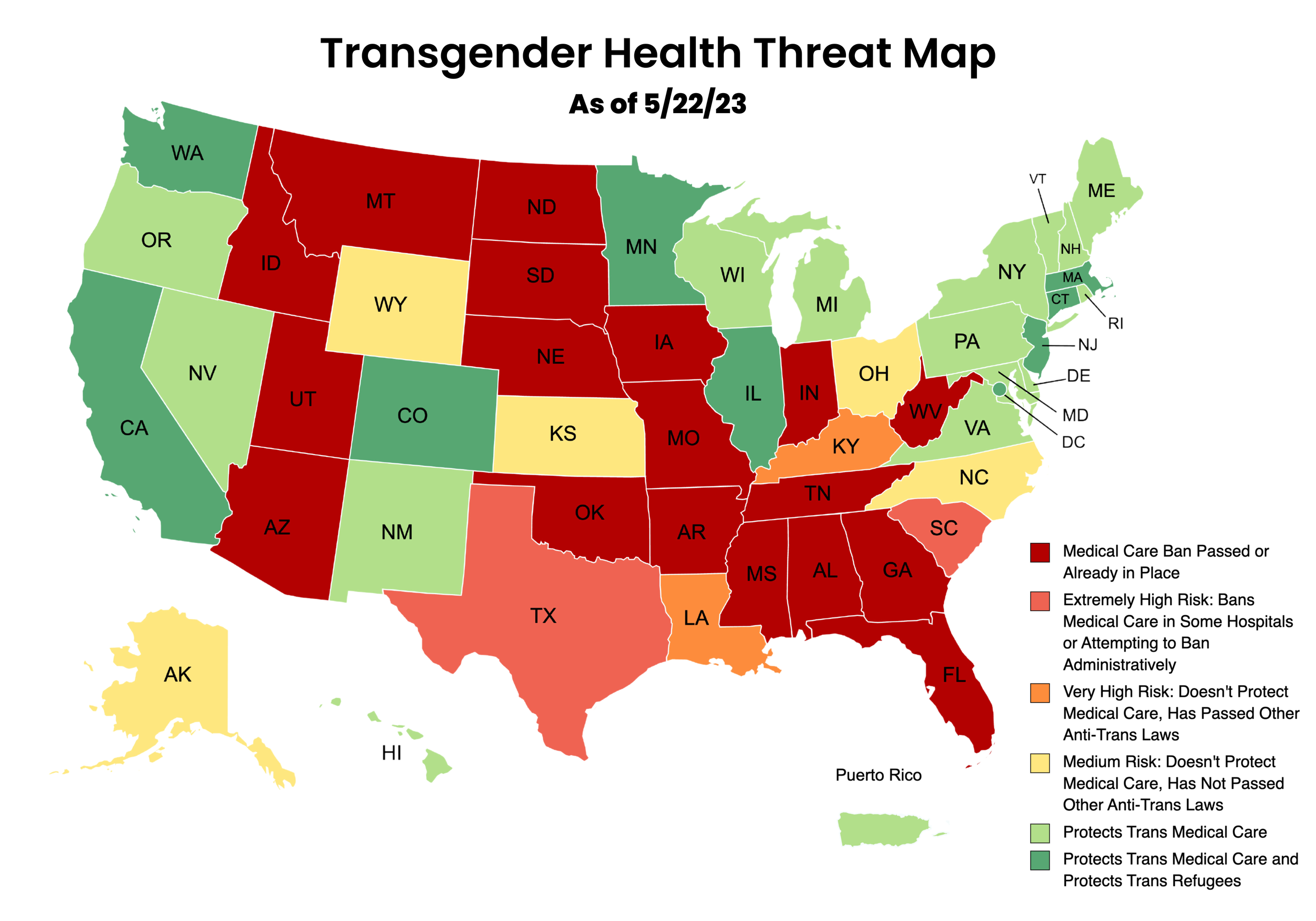
In total, nineteen states have now banned or attempted to ban life-saving best-practice medical care: Alabama, Arizona, Arkansas, Florida, Georgia, Idaho, Indiana, Iowa, Mississippi, Missouri, Montana, South Dakota, Tennessee, Texas, Utah, West Virginia, Nebraska, North Dakota, and Oklahoma. While each of these bans affect transgender youth, Florida’s ban baselessly attempts to make gender affirming healthcare illegal when prescribed by nurse practitioners, cutting off not only youth, but 80% of transgender adults in Florida from life-saving medical care. Additionally, the Missouri Attorney General attempted to ban lifesaving best practice gender-affirming care for all ages. While some of these bans have been enjoined by the courts, it is long past time to acknowledge the need for widespread political backlash laws, ungrounded in science, passed with the specific intent to end the existence of a marginalized group of people within the United States.
This wave of discriminatory laws flies in the face of wide consensus among doctors, providers, and medical researchers that gender-affirming care is lifesaving treatment that is often not received by those that need it. Laws denying that treatment will lead to serious injury and deaths of vulnerable transgender adults and children.
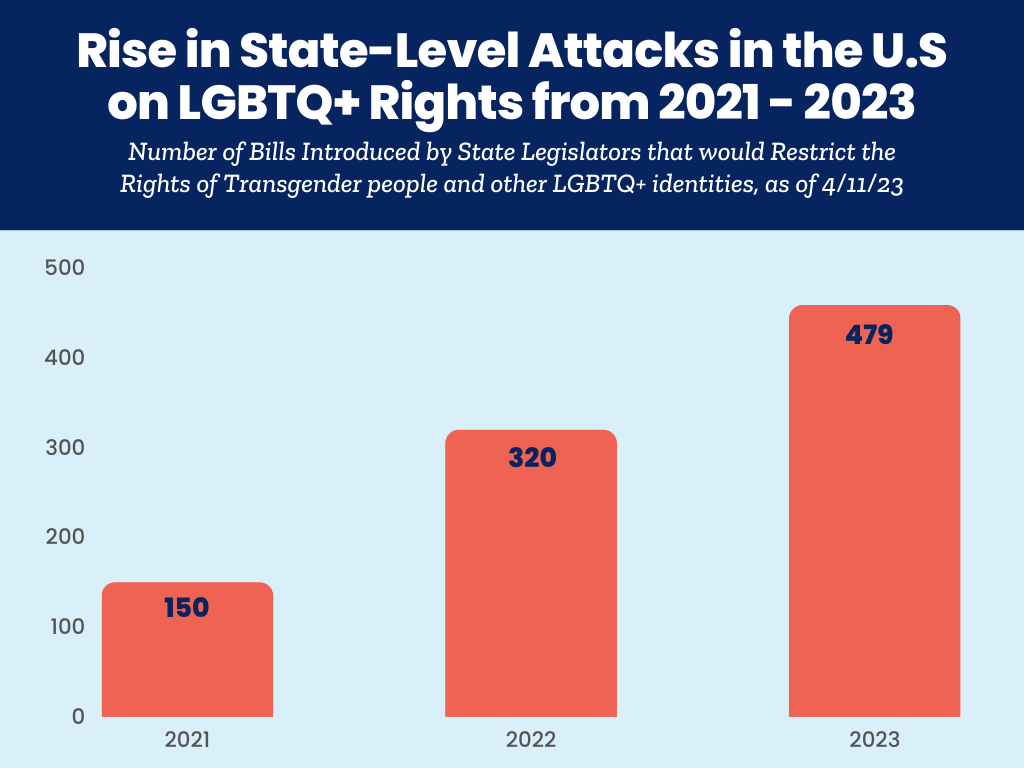
In 2023, attacks on trans health have escalated to a fever pitch, with a shocking number of over 479 specifically anti-trans bills introduced as of April 11, 2023.
So far this year, 45 states have introduced discriminatory bills that would harm gay, lesbian, transgender, and gender-non-conforming Americans, including bans on gender affirming care, restrictions on transgender students participating in athletics, criminalization of drag, gender performance and existing while trans, and more.
Yet more states both lack nondiscrimination protections for transgender people and have introduced bills restricting or banning transgender health care: Iowa, Kentucky, Louisiana, and South Carolina.
Though the majority failed, over 300 anti-LGBTQ bills were introduced last year, with the vast majority of them targeting the basic rights of transgender youth, such as access to healthcare, public accommodations, and education. At the close of the 2022 legislative session, 17 bills targeting trans youth passed into law.
Members of Congress led by Marjorie Taylor Greene have proposed a federal bill that would make providing best practice gender-affirming medical care for transgender minors into a felony nationwide. Representatives have also sought to prohibit schools from teaching students about gender identity without prior parental consent and limit transgender service in the military.
Despite this slew of attacks, transgender people’s rights are protected under the U.S. Constitution and federal and international law. States are breaking these laws and violating constitutional rights in their discriminatory treatment of transgender residents and visitors.
Methods used to attack transgender rights are being expanded to attack other rights, such as an Oklahoma bill that would falsely label respecting a child’s gender identity as felony child abuse, and which would also label the teaching of critical race theory or other “political or racial ideolog[ies]” to be the crime of felony child abuse.
These laws hurt our most vulnerable kids. Proponents of anti-trans legislation consistently repeat the false claim that the purpose of these laws is to protect minors, a strategy parroted by anti-abortion activists. For example, on April 6, 2023, Idaho passed a law that would define taking a minor across state lines to receive an abortion without their parent or guardian’s consent, as "abortion trafficking," punishable by up to five years in prison, despite the fact that most children in need of abortion are victims of rape. The passage of this law comes one year after Idaho attempted to pass legislation that would criminalize a parent taking their own child to another state to receive gender affirming care.

People are being denied basic civil liberties by absurd and often contradictory state laws. For example, Alabama law requires trans people to undergo genital surgery for a driver’s license but then outlaws best-practice gender-affirming health care for anyone under 19, functionally making it impossible for trans teens to drive.
These attacks disproportionately affect people of color who have less access to health insurance and face additional discrimination from their healthcare providers.
These attacks also hurt intersex people. In 2023, out of about 135 healthcare bans, there have been 98 intersex “carve-outs,” meaning that these gender-affirming care bans do not prohibit parents and doctors from approving and performing surgeries on intersex youth without their consent.
Lifesaving, best-practice health care for youth is being withheld.
Hospitals are having funds held hostage: South Carolina and Oklahoma have passed laws withholding crucial hospital funding if their administrations do not cease providing gender-affirming care to youth.
Boards of medicine and public health agencies are being weaponized: In 2022, Louisiana passed a law urging their Department of Health to perform its own research challenging the broad medical consensus that gender-affirming care (GAC) is basic medical care, and this March, Florida restricted care based on its own Board of Medicine’s counter-scientific narrative around GAC.
States are expanding the ability of health care providers and companies to invoke “conscience-based objections” to trans health care: Florida and Montana have both passed laws expanding health care providers and payors’ ability to refuse to participate or pay for health care services that they claim violate their conscience. These laws are written broadly and encompass all gender affirming healthcare and reproductive care.
Families are terrified as the wave of anti-trans policies sweeps across the nation, unsure where they can move and keep their loved ones safe. Many have already begun leaving their homes for states with more accepting laws, and others question how long they can stay.
A growing number of states are stepping forward to offer refuge to transgender people, their families and providers being persecuted by other state laws, as well as those seeking access to reproductive care. California led the way, with Colorado, Connecticut, District of Columbia (D.C.), Maryland, Massachusetts, Minnesota, and New Jersey, New York, Illinois, Vermont, and Washington following its lead to offer protection for people allowing, providing and receiving gender-affirming services
Transgender rights groups are out-funded by between $180 to $800 for every $1 raised by architects of extremist, anti-gender politics such as Charles Koch, Barre Seid and Leonard Leo, whose funds have also been connected to the fights to end abortion, censor school curricula, deny climate change, and prevent enactment of the Equal Rights Amendment (ERA). Beating this assault on transgender civil rights will require far greater coordination, support, and federal buy-in than is currently in place.
Trans allies in the House and Senate have recently introduced federal legislation to counteract these attacks through a Transgender Bill of Rights.
-
The first quarter of 2023 brought a previously unimaginable, and seemingly insurmountable, wall of 320 bills that directly seek to curtail transgender civil rights.
On April 13, Missouri Attorney General Andrew Bailey vastly expanded the scope of this country’s assault on transgender people, introducing an “emergency rule” that sought to prevent anyone in the state from receiving gender-affirming care. Though he previously advertised it as protecting minors, bolstered by propaganda, debunked testimony, and biased studies, the rule actually mirrored anti-abortion TRAP laws (targeted restrictions on abortion providers) in setting up so many barriers to care that providing it becomes impossible for adults to receive care, as well.
We are prepared to see more politicians follow this playbook in the weeks and months to come. As Lawyers for Good Government, National Center for Transgender Equality, and Trans Formations Project have found, in states across America, transgender lives are on the line.
This wave of laws flies in the face of wide consensus among doctors, providers and medical researchers that gender-affirming care is life-saving treatment that is often not received by those that need it, and that laws denying that treatment will lead to children’s deaths. It’s time for the law to stop being driven by regressive politics and instead follow science, precedent, and the basic, immutable human right of transgender people to exist.

-
The blatantly unconstitutional attacks on medically necessary healthcare being proposed by Florida and Missouri are but one part of a broader trend of politicians and extremists attacking the humanity of the transgender community.
As we reported last year, 2022 brought transgender people bomb threats at children’s hospitals, record levels of deadly violence against predominantly Black and Brown transgender women culminating in a vicious mass murder at Club Q, and bullying and harassment that left 80% of transgender young respondents to a national survey to suffer depression, stress, or anxiety that interfered with their learning last school year, making them top all youth in suicidality. But this year has brought a political tsunami of attacks on transgender existence, the likes of which this country had never seen.
Lawmakers are stoking fear and hatred against the transgender community as a “wedge issue,” using misinformation as justification to enact laws that further marginalize an already oppressed group, despite poll after poll showing that most voters are put off by this rhetoric.
The anti-trans platform has gained skyrocketing momentum over the last three years. In 2021, legislators proposed roughly 150 bills that would restrict the rights of transgender people and other LGBTQ+ identities in direct violation of the Bostock reasoning. Though the majority of the bills introduced in 2022 failed, states saw over 320 anti-LGBTQ bills proposed. The vast majority of these targeted the basic rights of transgender youth, such as access to healthcare, public accommodations, and education. A full 21 – two of which are still active – deemed supportive parenting and affirming care “child abuse” and sought to deny young people basic, best-practice medical care for gender incongruence, removing them from their families who support them.
Many of these copy-cat bills criminalize loving and accepting a transgender child and following a doctor’s advice to pursue standard-of-practice care for them. Michigan’s recently reintroduced bill states that anyone who “knowingly or intentionally consents to, obtains, or assists with a gender transition procedure for a child” is guilty of child abuse in the first degree. Parents, guardians, medical professionals, or anyone who cares for or has custody over a child can be charged with child abuse for helping a child access gender-affirming health care such as puberty blockers, surgeries, or hormone replacement therapy. Charges of child abuse in the first degree are considered felonies and are punishable by imprisonment any term of years, including life in prison.
Like the nearly-identical bans filed across the country, this bill also specifically allows for "corrective" procedures for intersex traits, laying plain its discriminatory nature: gender-affirming care is illegal, unless it reinforces the male/female binary. Out of 108 intersex carve outs, roughly 86 include chromosomal or genetic testing requirements for sex developmental disorders. These carve-outs indicate that these anti-trans legislation are restrictions to bodily autonomy and forces people’s identities into outdated cisnormative boxes. As Bria Brown-King, Director of Engagement for InterAct said in an article published by the 19th said, “So you’re saying that trans kids are too young to consent, but intersex kids aren’t? How does that make sense?”
Where anti-trans groups have failed to make traction using the legislative process, they have turned to much less democratic methods.
On April 13, 2023, Missouri’s attorney general used a highly suspect reading of the Missouri Merchandising Practices Act to decree, contrary to the law and medical science, that gender affirming care was experimental and providing it absent onerous conditions was fraudulent. It provided two weeks to gather documentation impossible to compile within that time, including that patients (1) have undergone what is commonly referred to as “gender-exploration” therapy, which is widely considered a form of conversion therapy; (2) were diagnosed with persistent gender dysphoria for over three years before initiating treatment and are re-assessed for dysphoria on an annual basis, which is ungrounded in science; (3) do not also experience depression or other mental health “comorbidities” and are not on the autism spectrum, which is ableist; (4) have signed an “informed consent” at the time of each “intervention” that forces them to acknowledge a number of debunked theories about gender dysphoria and (5) if a minor, have been screened for both “social media addiction” and “social contagion,” both of which are ungrounded in medical science. Under this rule, providers would be required to keep documentation on patients and track data about adverse effects in a form that is available for study.
Florida and Texas have also pushed through their own bans on care through executive fiat, only involving the legislature after Governor appointees issued rules.
After months of tense hearings and debate, Florida joined seven other states on March 16 in restricting transition-related medical care for minors through a first-of-its-kind process directed by the state’s Board of Medicine.
Even states whose citizens have elected democratic governor’s into office are not wholly protected. In Kansas, for example, lawmakers override democratic Governor Laura Kelly’s veto of two anti-trans bills. One bill, HB 2238, states that only biologically female students may play on female athletic teams. The other, SB180, establishes the women’s bill of rights to provide a definition of biological sex for purposes of statutory construction and narrowly defines “female” as only an individual whose biological reproductive system is developed to produce ova. This sets a dangerous precedent that other states are likely to duplicate. Governor Kelly also vetoed a ban on gender-affirming care for minors, which lawmakers narrowly failed to override.
On Friday, November 4, 2022, in a meeting at a Holiday Inn at Disney Springs in Lake Buena Vista, the Florida Board of Medicine (BOM) first voted to ban affirming health care for youth, despite unanimous guidance from the world’s leading medical organizations that such care is medically necessary. This was unusual, in that state medical boards are appointed bodies that regulate the practice of medicine in a state, such as how telemedicine is offered or how opioids are prescribed. The bodies oversee the issuance and revocation of medical licenses. Gov. Ron DeSantis’ Department of Health had urged the Board to create the rule in August, the same month the Florida Agency for Health Care Administration prohibited its state Medicaid from covering gender-affirming care (which a federal judge upheld in October). According to an analysis by the Tampa Bay Times, despite self-identifying as “apolitical,” the board’s members have donated over $80,000 to Governor DeSantis’ campaigns for state office and his political committee.
Earlier in 2022, the Florida Department of Health had published a thoroughly-debunked document that advised against giving transgender young people any gender affirming care, including even “social transition,” which is simply acknowledging a child is the gender the child says they are. A ban on social transition is effectively state-legislating certain behaviors as “normal” based on gender, and creating state-enforced gender roles. This sort of policing of gendered behavior has harmful impacts not only on transgender and nonbinary people, but cisgender and gender non-conforming people, as well.
At a final public hearing on February 10, numerous experts testified that the rule contradicted most medical evidence, as well as guidance from nearly all relevant medical associations, but Dr. Hector Vila, a pediatric anesthesiologist and Board of Medicine member, disagreed, saying the board had “reviewed hundreds of studies.”
Last February, Texas directed its Department of Family Protective Services (DFPS) to investigate caregivers who authorized gender-affirming care for their children for child abuse. At the moment, these measures in Alabama, Arkansas and Texas are currently blocked in court, making Florida’s the first active ban on healthcare for transgender youth when it went into effect on March 16. An identical law went into effect for osteopathic doctors March 28. Four families have filed suit to challenge the law. In May, 2023, Texas Attorney General Ken Paxton ordered an investigation into whether gender-affirming care procedures were “unlawfully performed on minor children” at Dell Children’s Medical Center; he did not specify which laws were allegedly broken, but issued a “request to examine” the hospital’s documents and policies regarding gender-affirming healthcare.
Florida’s legislature expanded upon the Board of Medicine ban with its own bill, SB 254, which was signed into law on May 18, 2023. The bill inflicts criminal penalties on gender-affirming care providers, rescind provider licenses, and prohibit Medicare from covering gender-affirming care for transgender youth or adults. It would also prohibit the use of public funds, including those of a public university, public hospital, city, or county, and Medicare, to provide benefits that include gender-affirming care for transgender people of all ages. Most frighteningly, the law would allow the state’s child welfare agency to remove trans children from their parents if they are receiving transition care by arguing that Florida family courts have emergency jurisdiction to set aside another state’s custody determination for a young person if their parents have authorized or might authorize best practice, age-appropriate, gender-affirming care. Florida’s passage of SB254 was accompanied by the signing of three other anti-LGBTQ+ bills, including: SB 1438, a ban targeting drag performances that could also impact Pride permitting; HB 1069, an expansion of Florida’s “Don’t Say Gay” bill, which restricts pronoun use in both public and private schools and prohibits discussion of gender identity or sexual orientation in the classroom; and, HB 1521, a trans bathroom bill which allows individuals to ask trans folks to leave the bathroom that aligns with their gender identity and attaches criminal penalties if the trans person fails to do so.
Even states whose citizens have elected democratic governor’s into office are not wholly protected. In Kansas, for example, lawmakers override democratic Governor Laura Kelly’s veto of two anti-trans bills. One bill, HB 2238, states that only biologically female students may play on female athletic teams. The other, SB180, establishes the women’s bill of rights to provide a definition of biological sex for purposes of statutory construction and narrowly defines “female” as only an individual whose biological reproductive system is developed to produce ova. This sets a dangerous precedent that other states are likely to duplicate. Governor Kelly also vetoed a ban on gender affirming care for minors, which lawmakers narrowly failed to override.
-
Each of the attempts to ban medical care, including Missouri’s latest ban, fly in the face of wide consensus among doctors, providers, and medical researchers that gender-affirming care is lifesaving treatment that is often not received by those that need it.
Recent, peer-reviewed studies in The Lancet and American Academy of Pediatrics show that a full 98%, or 49/50, transgender people retain their identity over their lifetime. A 2021 meta-analysis that pooled results from 27 studies of 7928 transgender patients found the satisfaction rate with gender affirming care even higher – 99% – and reported that most of the patients who regretted transitioning felt that way because of the transphobia and rejection they faced.
Gender-affirming care, including surgery, has much higher satisfaction rates than most other types of medical care, leading to increased quality of life and decreased negative mental health outcomes for both transgender youth and adults. A 2022 study published in the Journal of the American Medical Association (JAMA) reported that receipt of gender-affirming care, including puberty blockers and gender-affirming hormones, was associated with 60% lower odds of moderate or severe depression and 73% lower odds of suicidality over the following 12 months.
Gender-affirming care is backed by a solid base of evidence and supported by every major U.S medical and mental health organization, including the American Medical Association, American Academy of Pediatrics, Federation of Pediatric Organizations, American College of Obstetricians and Gynecologists, and American Psychological Association.² The last twenty years have shown vast improvements in research on gender-affirming care, leading to higher-quality data that we can better rely on to guide policymaking.
Further, despite the testimony of a small, well-compensated group of “detransitioners” that are flown around the country to lobby against GAC at hearings and in litigation, among the few people who have detransitioned, a 2021 study reported that 82.5% did so because of external pressures such as fear of violence, rejection from family, and discrimination in education or employment.
Regardless of the reasons why a person has detransitioned, they should be allowed to do so without stigma and should have access to any gender-affirming medical care they need to be comfortable with their bodies, just like everyone else. Any dissatisfaction or regret they may feel about their medical transition does not change the fact that medical transition is the right decision for the majority of people who undergo it. Most people who detransition continue to support the rights of transgender and nonbinary people, and it is wrong to exploit their experiences to attack access to lifesaving medical care for those who need it.
The reasoning in these interpretations applies with equal force to discrimination against intersex people, who are also harmed by these laws. “Intersex” refers to people born with variations in physical sex characteristics—including genitals, gonads, chromosomes, and hormonal factors—that do not fit typical, binary definitions of male or female bodies. The Bostock Court addressed discrimination against “persons with one sex identified at birth and another today.” Discrimination against intersex individuals is similarly motivated by perceived differences between an individual’s specific sex characteristics and their sex category (either as identified at birth or some subsequent time). In other words, it is impossible to discuss intersex status without also referring to sex. Discrimination based on intersex traits may also involve sex stereotypes, as intersex people by definition have traits that do not conform to binary stereotypes about male or female bodies.
-
Transgender, nonbinary, two-spirit and other gender-diverse people are protected from discrimination “on the basis of sex” under the United States Constitution. On June 15, 2020, the Supreme Court held in Bostock v. Clayton County that sex discrimination under Title VII of the Civil Rights Act of 1964 (“Title VII”) encompasses discrimination on the basis of both sexual orientation and transgender status.
In light of the Bostock decision, on January 20, 2021, President Biden signed Executive Order 13988, which affirmed that federal antidiscrimination laws prohibiting sex discrimination necessarily “prohibit discrimination on the basis of gender identity… so long as the laws do not contain sufficient indications to the contrary.” That order directed federal agencies to review all “existing orders, regulations, guidance documents, policies, programs, or other agency actions” that implement antidiscrimination provisions on the basis of sex and extend those protections to gender identity.
In compliance with Executive Order 13988, the Department of Health and Human Services issued a notification in May of 2021 affirming that it would “interpret and enforce Section 1557’s prohibition on the basis of sex to include… discrimination on the basis of gender identity.” In March of 2022, HHS’ OCR released further notice that Section 1557 prohibits discrimination based on gender identity, including restrictions to gender-affirming care. In October, the agency closed its comment period for a revised Section 1557 rule, which would render these protections more explicit and expand them to health insurers.
This federal rulemaking is in recognition that the simple fact of being transgender can lead to health challenges that go beyond gender-affirming care. In 2021 alone, 37% of transgender people avoided needed medical care and 41% preventative screenings because of previously experienced discrimination.
Transgender people of color in the United States face multiple forms of interpersonal discrimination—both independently and simultaneously—in health care settings, including cissexism, racism, weight-based discrimination, and ableism. The compounding of bias based on categories of difference (e.g., gender, race, social class, ability) leads to a systemic “othering” of transgender people that results in significant health disparities. Health discrimination is even worse for transgender people of color, who face higher discrimination rates than both white transgender people and their cisgender peers of color. While one-third of respondents to the National Center for Transgender Equality’s 2015 United States Transgender Survey (USTS) who had seen a provider in the past year reported having at least one negative experience with a doctor or other health care provider related to being transgender, that rate increased to 50% for American Indian respondents, 40% among Middle Eastern respondents and 38% among multiracial respondents.
As reported in the USTS, this further leads to shocking differences in access to basic necessities such as income, employment, housing and basic healthcare. While respondents in the USTS sample overall were more than twice as likely as the U.S. population to be living in poverty, respondents who were people of color, including Latino/a/é (43%), American Indian (41%), multiracial (40%), and Black (38%) respondents, were more than three times as likely as the U.S. population (12%) to be living in poverty. The unemployment rate among transgender people of color (20%) was four times higher than the U.S. unemployment rate (5%). Black transgender and gender non-conforming people often live in extreme poverty, with 34% reporting a household income of less than $10,000/year, in comparison with eight times the general U.S. population rate at 4%.
Transgender people are also more likely to be impacted by the child welfare system, where they are 2.5 times as likely to be placed in a group home than their cis counterparts and twice as likely to be mistreated. A 2019 AAP study and a 2014 Williams Institute study found youth in foster care and unstable housing to be up to five times more likely to be trans, with 5.6 percent of children in foster care being transgender and over 11 percent nonbinary and showed transgender children of color to be even more vulnerable. Since COVID-19, Children’s Rights reports that conditions for transgender youth have gotten worse, with some transgender youth forced back into the closet as they had to return to unsupportive homes during the pandemic.
Transgender people, especially transgender people of color, are also disproportionately incarcerated, sexually abused and physically assaulted. The vast majority of transgender people who are imprisoned are placed in facilities based on the sex assigned to them at birth, leading to high rates of sexual assault and extreme violence. Even outside of prison, transgender people are over four times more likely to be victims of violent crime than cisgender people.
Given these well-documented disparities, the Biden-Harris administration has offered robust additional support for the Supreme Court’s Bostock analysis across its agencies. On March 26, 2021, the the U.S. Department of Justice (“DOJ”) Principal Deputy Assistant Attorney General for the Civil Rights Division issued a memorandum to federal civil rights offices and general counsels addressing the application of Bostock to Title IX, determining that Title IX’s prohibition on discrimination “on the basis of sex” includes discrimination on the basis of gender identity and sexual orientation.
As the DOJ explains in its Title IX Legal Manual, Bostock’s holding further extends to guiding Title IX interpretation, an analysis agreed to by a number of federal circuit courts.
On June 22, 2021, the U.S. Department of Education issued a notice of interpretation clarifying that “[c]onsistent with the Supreme Court’s ruling and analysis in Bostock, the Department [of Education] interprets Title IX’s prohibition on discrimination ‘on the basis of sex’ to encompass discrimination on the basis of sexual orientation and gender identity.” While one district court has held that this analysis improperly hinders state law, on June 23, 2022, the 50th anniversary of the passage of Title IX, the Department of Education began the process to make these protections explicit. The new Regulations are not effective for the current 2022–2023 academic year but will likely be modified and codified before next academic year. If codified into federal law, the proposed Title IX Regulations would protect the rights of transgender youth in schools, including access to bathrooms and other school facilities consistent with an individual’s gender identity.
-
In addition to laws banning gender affirming care for minors, extremist groups have also begun to take aim at healthcare for adults. Missouri’s April 13 gender-affirming care ban is the first in its country to attempt to implement banning lifesaving best practice gender-affirming care for adults. The Missouri ban follows a pattern long seen in the attacks on reproductive rights and known as “TRAP Laws”. Instead of outlawing gender-affirming care directly, it puts onerous conditions on accessing the care that are either difficult or impossible to achieve. If the rule is allowed to go into effect, we can expect to see copycat rules put forth, like we did in the anti-abortion campaign.
Additionally, this year there were at least 22 bills that, if enacted, would limit gender-affirming care for all transgender adults, and 12 bills that would limit gender-affirming care for some transgender adults above eighteen years old. Legislation limiting healthcare for adults has different legal implications than laws restricting care for minors, and litigation challenging these laws will likely take a different approach.
Politicians may have greater discretion to limit the rights of minors, because those rights are balanced against the responsibility undertaken by parents and the state to protect the well-being of children. However, this balancing of interests is not present in the context of laws restricting healthcare for adults. During Congressional debates over the Bill of Rights, members insisted that a person’s “uninterrupted enjoyment of his life, his limbs, his body, his health” was a bedrock right, guaranteed to all. And, expert legal and moral scholars have agreed that “[u]nder the constitutional order, certain human rights are elevated into legally enforceable rights, so that if a law infringes on these moral rights, the law is not valid.” Courts have also used the constitutional mechanism of judicial review to reinforce the right of adults to self-determination and protect these human rights from government transgression.
The text of the Constitution guarantees a right to privacy, bodily autonomy, and dignity through the Fourth Amendment protections against unreasonable searches and seizures, Eighth Amendment protections against cruel and unusual punishment, and the Fifth and Fourteenth Amendment rights to due process and equal protection of the laws. Case law interpreting these amendments has concluded that the rights to dignity and bodily autonomy encompass the right of adults to make individual healthcare decisions. Based on this analysis, laws restricting access to gender-affirming care for some because of their gender identity or failure to self-identify in one of two narrowly-defined and unscientific sex categories are unconstitutional. Unlike challenges to healthcare bans for minors, if laws challenging healthcare bans for adults pass, this litigation will not have to overcome arguments related to parental rights that litigation will not need to overcome arguments related to parental rights, and it would focus purely on the already established constitutional rights discussed above.
While the Biden Administration and numerous congresspeople have sought to explicitly enshrine transgender, non-binary, two-spirit and gender-nonconforming rights into law through measures like the Equality Act and original Transgender Bill of Rights filed last June, these efforts have thus far failed to achieve the necessary bipartisan support necessary to push them through before Republicans took the House of Representatives this session.
At the state level, however, some legislatures are also passing laws friendly to transgender Americans, and some states like Nevada are even amending their state constitutions to make expressly clear that they protect transgender rights. It is time for every state to follow suit.
On March 9, 2023, Minnesota Governor Tim Walz signed an order protecting and supporting access to gender-affirming health care for all LGBTQIA+ people in the state.
"Minnesota strives to be a welcoming and supportive place for LGBTQIA+ community members," the executive order read. "We uphold the essential values of One Minnesota when all people, including members of the LGBTQIA+ community, are safe, celebrated, and able to live lives full of dignity and joy."
On March 31, Minnesota passed a transgender refuge law, authored by the state’s first transgender legislator, Leigh Finke. It passed 68-62 at roughly 5 a.m. that morning, after a heated session debating a number of bills.
"In the staggering rise of anti-transgender and anti-LGBTQIA2S+ legislation by extremist Republicans, Minnesota is a beacon of hope for trans and gender-expansive children and their families," Rep. Leigh Finke, DFL-St. Paul, said. "The passing of the Trans Refuge bill will send a strong message to the trans community that they are loved, supported, and protected here in our state."
California was the first state to offer refuge to trans youth and their families fleeing persecution with Senate Bill 107, which went into effect January 1. Colorado, Connecticut, Maryland, Massachusetts, Minnesota, New Jersey, New York, Illinois, Washington state, and Washington, D.C. have also adopted “trans refuge” laws offering similar protections to their residents.
As states pass these refuge laws, it is worth noting that the fight for access to transgender and reproductive healthcare are inextricably linked, the right to ensure bodily autonomy and have access to best practice medical care. Each of the states that protected trans youth and their families fleeing persecution has also protected people seeking freedom from persecution from laws seeking to deny them access to reproductive freedom. In fact, many of the bills granting these protections included protection for both transgender and reproductive healthcare. The opposition uses the same toolkit of anti-autonomy strategies against both movements, and the defense of these movements must continue to be similarly united and aligned.
LGBTQ+ lawmakers in sixteen other states have put forth similar legislation this session, including Colorado, Connecticut, Florida, Georgia, Illinois, Kansas, Kentucky, Maine, Michigan, New Hampshire, New Mexico, Oregon, Rhode Island, Vermont, Washington and West Virginia. Ironically, some of these same states have instead passed the most viciously anti-trans laws this term, Florida, Georgia, and West Virginia.
Other state laws offer vital protections to transgender people and their families. For example, California, Delaware, Hawaii, Illinois, Maine, New Hampshire, New Jersey, New Mexico, New York, Oregon, Vermont, Virginia and Washington, D.C. have enshrined protections for transgender health insurance access in the state code, prohibiting discrimination based on actual or perceived gender identity. Since Gov. David Ige signed House Bill 2405 into law on June 17, 2022, the Hawaii health insurance code protects transgender Hawaiians from discrimination by health insurers "on the basis of actual gender identity or perceived gender identity," and prohibits “categorical cosmetic or blanket exclusions to gender-affirming treatments or procedures.”
Further, Colorado, Connecticut, Maryland, Massachusetts, Michigan, Minnesota, Montana, Nevada, Pennsylvania, Rhode Island, and Wisconsin have issued insurance bulletins clarifying that their laws protect transgender rights to nondiscrimination in insurance.

-
Equitable access to safe, affirming and scientifically-validated medical care is a backbone to a just, democratic society. The US Constitution protects discrimination on the basis of sex and gender identity when seeking that care. Transgender people living in America are entitled to live long, healthy lives free from government-sponsored discrimination and harassment, including that introduced in state law. As these unconstitutional laws continue to be challenged in court, it is up to state and national legislators to pass bills that further enshrine the rights of all people, regardless of gender identity, to continue to have access to medical care.
One hopeful sign is the bicameral reintroduction of the Transgender Bill of Rights by Rep. Pramila Jayapal (D-WA) and Sen. Edward Markey (D-MA) just before TDOV this March. The bill seeks to amend the Civil Rights Act to prohibit discrimination on the basis of sex, enforce prohibitions on discrimination in health care on the basis of gender identity, and amend federal education laws to ensure that trans students are protected from discrimination. It also clearly interprets Title IX as allowing students to join sports teams that match their gender identity, preempting bans passed by legislatures across the country.
As Sen. Markey said upon reintroduction of the Transgender Bill of Rights: “Lives are at stake.” These bills aim to take away the fundamental rights of transgender people, restrict everyone’s right to bodily autonomy, erase the transgender community’s history, and force all gender non-conforming people into isolation. But we have the majority of Americans on our side, and a powerful community that refuses to be erased. Extremist politicians are on the wrong side of the Constitution, science, and our country’s growing pluralism. Now is the time to stand up, together, and fight back against this bigotry.
-
Khadijah M. Silver (they/them) is Supervising Attorney - Civil Rights at Lawyers for Good Government and a longtime advocate for transgender rights, most recently at Transgender Legal Defense and Education Fund (TLDEF).
Mika Fernandez (she/her) is a civil rights attorney, Vice President of Policy and Strategic Engagement at Lawyers for Good Government (L4GG), and a board member of the Trans Formations Project (TFP).
Alex Petrovnia (he/him) is the Founder and President of the Trans Formations Project, a volunteer-run 501(c)(4) nonprofit dedicated to tracking and educating about the anti-trans legislative crisis in the United States.
Devon Ojeda (they/he) is a senior national organizer at the National Center for Transgender Equality and has been a lifelong healthcare rights advocate. Previously they were a fellow for the Senate HELP Subcommittee on Primary Health and Retirement Security in the Office of Senator Bernard Sanders.
Thank you to Trans Formations Project Vice-President Sami Mendum-Purdy, NCTE Outreach Manager Alex Del Rosario, L4GG Staff Attorney Alyssa Morrison, each of the volunteers with the Trans Formations Project, and each of the L4GG pro bono attorneys and law firms who contributed to the research used in this report.
This report was last updated on June 22, 2023. Bills enacted after this date may be accessed through the Anti-Trans Legislation bill tracker by the Trans Formations Project, co-author of this report. Nothing contained herein is intended to be used as legal advice nor creates a client-lawyer relationship.
““Lives are at stake.”
- Senator Ed Markey, upon reintroduction of the Transgender Bill of Rights”

state-level findings
To view state-level findings, please click on one of the state names listed below. If you have a proposed update to the findings in your state, please click here.
NOTE: Due to recent changes in the law, we’re updating this research and hope to have this section back up soon!
Footnotes
Please note that when used independently in this report, the term “transgender” is meant to encompass the wide group of people who identify as a gender other than their assigned sex at birth or who fit outside of the gender or sex binary. This may include people who are intersex, nonbinary, two-spirit, genderqueer, genderfluid, gender nonconforming, or identify as a third gender associated with another culture. We acknowledge that not all people who fit under this umbrella identify themselves as transgender, and intend this report to apply to all people who experience discrimination on the basis of their sex or gender.
At least 29 leading medical organizations recognize the necessity of gender-affirming health care. Medical associations that endorse comprehensive gender-affirming health care for transgender people further include the Endocrine Society, Pediatric Endocrine Society (“PES”), American Academy of Child and Adolescent Psychiatry (“AACAP”), the American College of Osteopathic Pediatricians (“ACOP”), the National Association of Pediatric Nurse Practitioners (“NAPNAP”) and the World Professional Association for Transgender Health (“WPATH”).